Popular Posts

Showing posts with label Crichton. Show all posts

Monday, September 10, 2012

Lucifer's Hammer - Larry Niven & Jerry Pournelle


Well now this was good. Very good. A comet is spotted by a playboy millionaire/part-time stargazer who uses it to promote his image and get a television documentary. This turns into a sort of Doomsday phenomenon, complete with a prophet spreading the word of God about our Judgement, sort of like Marshall Applewhite or that Harold Camping guy, except this bullshit happened in real life and not in a science fiction book written 35 fucking years ago.

The book also features some of the wonders of contemporary science. Space shuttles were just getting going, but the astronauts in this book use an Apollo craft to team up with awesome Russian kosmonauts. There are many characters in this story, but none top the guy who works at the Jet Propulsion Laboratory (more on him later). The authors’ take on JPL and the magic those nerds are able to generate is really wonderful. I read this book shortly after the Mars Curiousity landed, and was able to view the landing via a stream online, straight from JPL command center. I also was fortunate enough to attend the landing party for our previous mission to Mars, Phoenix, as the University of Arizona coordinated that mission with JPL. Being in the nerd-command-center for those moments is really exciting, and Pournelle and Niven capture the essence perfectly.
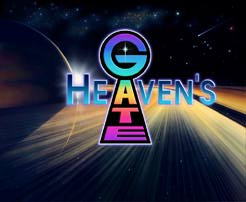
(Lesson from Marshall Applewhite: if you're gonna start a cult, pick a logo that's slightly more timeless)

Once the comet hits, much of the writing oscillates between a sort of Crichton-paced action adventure Doomsday book and a very clever post-apocalyptic thriller. Some scenes just stand out more, and are usually isolated and short, but the one that jumps out to me the most is the diabetic scientist from JPL, Dr. Forrester, bagging his entire library, each book in several sets of Ziploc bags, and stashing them away for safe keeping after society is completely destroyed. It was almost as if he had read all of the same post-apocalyptic books that I have read and did what I thought I would do in that situation.

(Illustration from the book? Nope. Harold Camping's fucking people.)

As society really falls apart, with looting leading to survivalist campaigns of hostile cannibals – another post-apocalyptic touch I really appreciated – a Senator with a ranch and hot daughter look to save the day for everyone in the Southern California area (the focus of virtually all the action). Things go well for this society until they inevitably have to deal with the cannibals, and if not for the saving grace of science, which is complemented by people saving science in the battle of the nuclear powerplant (a great mirroring of our relationship with science), things would get even more gruesome than they do. Which would have been fun, of course, but I’m happy with how things turned out.

This book had just about everything I need: end of world, cannibals, scientists being badasses, shit-hits-the-fan scenarios and people’s planning around the apocalypse (i.e. guns, food, water; always something to learn), religious cukes and a cult-like mentality, babes, a cameo by a Dodge Dart, Russians, inappropriate relationships between Scout leaders and girl scouts (and underage boys and underage girls, for that matter) and more cannibals.

To say this book is a good time is an understatement. 

Saturday, June 30, 2012

Michael Crichton's Sphere


Oh right, I have read Sphere, I had almost forgotten. I am unsure as to whether or not it is because I am getting older, or maybe just evolving in my taste for literature, but though I respect what Michael Crichton brings to the table (Science! Reason!), it never seems to match up, even comparably, with what I felt when I read Andromeda Strain. Again, that's not a knock on Crichton, but I just do not find much of his later books – or maybe any of his other books for that matter, including his earlier works (The Great Train Robbery, The Terminal Man to some extent) – all that engaging.

So Sphere, I shall start with what I liked. Of course, I always like the pace with which he writes. His books read like you are watching a movie. Just like Dan Brown novels. But there are things you lose in those types of books. Unfortunately, this is not a Michael Crichton review it is a Sphere review so if you do not understand what that pace is like and how it affects book/movie plotlines, I won't be covering it here. Moving on.

I also liked the influence of science. Of all the criticisms we can give Michael Crichton, one we cannot dish out is that the mother fucker didn't do his research. This guy had a mathematician, an astro-physicist, a psychologist and a biologist, plus Navy/Military and US Defense aspects all effecting the plot in a way that twists the story into itself and forces the people's ideals to clash and at times implode on their little underwater society.

It takes us some time to research these different fields and weave a story with them, and we have the benefit of internet. I have to believe Crichton's struggles to intertwine all this in 1987 (yeah, that's another thing, can you believe this was published in 19fucking87?) were a bit more difficult than I would guess, being a child born shortly before the book was published. In other words, he got off his ass and went to the library more than I have ever felt the need to, of that I am certain.

A very novel concept, with very novel science and well-thought out backgrounds, characters and plots, typical Crichton. But, in typical Crichton fashion, it just doesn't pull together in a way that grips me. Sure, it is a real page-turner, but more because of the pace and less because the writing is great. The writing is actually, to be honest, not good. I think what drew me in was that I am a man of science, but that sometimes acts as a double edged sword and I get annoyed with little mistakes, which seem to me in certain lights as glaring, obvious errors.

So when I read “strong odor of ammonium” and “ammonia fumes” on adjacent pages, I flip shit (Sphere, Michael Crichton, Harper Collins © 2006). Ammonia is NH4+, making it a cation where ammonia is the chemical we smell and clean with. If you have had a chemistry class you know they are very, very different things. Still, this is not Crichton's biggest error.


His biggest error in this story for me was just how weak and feeble a military organisation trying to investigate the biggest discovery in human history (and trying to weaponise it) could be so insubstantially backed up, in terms of personnel and contingency planning. I know we always portray the military as being short-sighted, gung-ho and absolutely confident the point of no return at times, but having family in the military I know they're actually very thorough most of the time. And that “one time” they aren't thorough seems to be the whole punch line of every book that ever uses military intervention as part of its plot.

Can we get over that, yet? It really is an annoying trait stories need to rely upon to get the message through. Other than all that, I thought it was a decent story. The movie gets some of it right but ends up in a mess of people unable to control their thoughts and narrowly escaping, and with way more unnecessary dramatics, but I'd honestly say you don't lose too much watching the movie over reading the book (even thought I'm a smug bastard who typically, pretendingly, judges people who watch movies over reading the books). Plus, I cannot hate the movie too much, it does have Peter Coyote, with his voice in all its glory, and Sam Jackson. He doesn't make bad movies, does he?

Not a poor book, but certainly nothing to be smug about having read it. That's my final thought.