Popular Posts

Showing posts with label Doomsday. Show all posts

Wednesday, July 17, 2013

Cat's Cradle - Vonnegut


A dark, satirical, humourous middle finger extended to everyone in Capitalist Christian and Science Loving America for about 250 rapid-fire pages that takes us through the post-war United States and the defilement of social structure which we felt necessary to sacrifice for peace, and ends up in a completely dystopian, end-of-world, doomsday moment of Zen on a deserted island. What could be more fun?

I read this book in order to become more familiar with the works of Mr. Vonnegut. I'm not too huge a fan of his work, if you can believe it. The only book I had read prior to this that he has written was Slaughterhouse V. And even though it makes nearly everyone's list of American books from the last century that are must reads, I just was not too impressed by it. It was simple, and whilst trying to come of as sad, almost seemed to come of as pathetic. To make matters worse, I just really did not understand why it has such a religious following. Honestly, if I never met a guy with a tattoo of a quote from that book on his arm, I may have been able to enjoy it more.

I think another part of the problem was that I felt I was missing something. Like there was a truly epic experience that the book offered that I just missed out on, probably due to the fact that I skipped out on reading Slaughterhouses I through IV. "This tends to happen when you pick up Book V and start there," I thought. "Surely someone did the same with 'Heretics of Dune' or 'Harry Potter and the Fifth Book of the Franchise.'"


Anyway, you don't need a fanatic loyalty pledged to Kurt Vonnegut to be able to enjoy this book. It just is, on its own, very enjoyable, fast, and darkly funny. Its statement on religion, philosophy, and science is tremendous and, if you are quite the cynic, accurate. Celebrating a genius like Albert Einstein for giving us the power of atomic energy, probably not the best idea. Let alone thinking about that power and knowledge in the wrong hands. Really made me want to go jam to O.M.D’s popular 80’s hit, and one of the best songs of 80’s electronica bar none, Enola Gay. 
This book has indeed inspired me to go for more in terms of Vonnegut literature, even though I maintain I am not a devout follower, nor even yet a fellow traveller. Which reminds me, you can claim loyalty not to him but to fun phrases and terms he makes up: like Bokononism, wampeters, granfalloons (people pretending to be a part of a made-up cause), so it goes (death), and, thanks to the next Vonnegut book I've started:  chrono-synclastic infundibulum.

Monday, September 10, 2012

Lucifer's Hammer - Larry Niven & Jerry Pournelle


Well now this was good. Very good. A comet is spotted by a playboy millionaire/part-time stargazer who uses it to promote his image and get a television documentary. This turns into a sort of Doomsday phenomenon, complete with a prophet spreading the word of God about our Judgement, sort of like Marshall Applewhite or that Harold Camping guy, except this bullshit happened in real life and not in a science fiction book written 35 fucking years ago.

The book also features some of the wonders of contemporary science. Space shuttles were just getting going, but the astronauts in this book use an Apollo craft to team up with awesome Russian kosmonauts. There are many characters in this story, but none top the guy who works at the Jet Propulsion Laboratory (more on him later). The authors’ take on JPL and the magic those nerds are able to generate is really wonderful. I read this book shortly after the Mars Curiousity landed, and was able to view the landing via a stream online, straight from JPL command center. I also was fortunate enough to attend the landing party for our previous mission to Mars, Phoenix, as the University of Arizona coordinated that mission with JPL. Being in the nerd-command-center for those moments is really exciting, and Pournelle and Niven capture the essence perfectly.

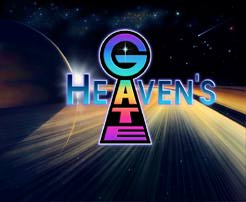
(Lesson from Marshall Applewhite: if you're gonna start a cult, pick a logo that's slightly more timeless)

Once the comet hits, much of the writing oscillates between a sort of Crichton-paced action adventure Doomsday book and a very clever post-apocalyptic thriller. Some scenes just stand out more, and are usually isolated and short, but the one that jumps out to me the most is the diabetic scientist from JPL, Dr. Forrester, bagging his entire library, each book in several sets of Ziploc bags, and stashing them away for safe keeping after society is completely destroyed. It was almost as if he had read all of the same post-apocalyptic books that I have read and did what I thought I would do in that situation.

(Illustration from the book? Nope. Harold Camping's fucking people.)

As society really falls apart, with looting leading to survivalist campaigns of hostile cannibals – another post-apocalyptic touch I really appreciated – a Senator with a ranch and hot daughter look to save the day for everyone in the Southern California area (the focus of virtually all the action). Things go well for this society until they inevitably have to deal with the cannibals, and if not for the saving grace of science, which is complemented by people saving science in the battle of the nuclear powerplant (a great mirroring of our relationship with science), things would get even more gruesome than they do. Which would have been fun, of course, but I’m happy with how things turned out.

This book had just about everything I need: end of world, cannibals, scientists being badasses, shit-hits-the-fan scenarios and people’s planning around the apocalypse (i.e. guns, food, water; always something to learn), religious cukes and a cult-like mentality, babes, a cameo by a Dodge Dart, Russians, inappropriate relationships between Scout leaders and girl scouts (and underage boys and underage girls, for that matter) and more cannibals.

To say this book is a good time is an understatement. 

Wednesday, February 29, 2012

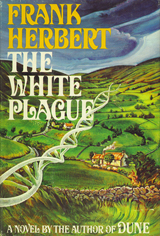
White Plague - Frank Herbert

Frank Herbert is one of the best authors of all time, not just science fiction. And if you need any proof of this, I’d recommend a fairly non-sci-fi book like this. It covers a massive range of issues, from morality and religion to violence and war, science and politics and of course, the ever interesting “what-if” doomsday scenarios.

There’s also a range of characters, predominantly American, Brits and fucked up Irish. And not the great, St. Patrick’s Day everyone wearing green and listening to U2 or Dropkick Murphy’s Irish, I’m talking about the real Irish. The ones who are violent, hateful dickbags with a penchant for getting under people’s skin and holding grudges with them until the end of the world looms near.

But through all the violence and hatred, Frank Herbert has a way of conveying the heart of the issue without actually writing anything of the violence. You just hear about it after it has already happened, it is really quite brilliant. The very beginning is the only time in which violence is described in detail, and that is what sets off the entire plague.

An American (of Irish descent) in Dublin loses his family courtesy the IRA and basically goes batshit. He spends the next stage of his life retracting into a home-made basement laboratory creating a disease that will kill women. All women. So that Ireland (the place he lost his family), the source of their extremists’ weapons (Libya), and the source of their pain (Great Britain) will know his despair when their women parish. Scientists and politicians from around the world unite to find a cure, or even just to know what is happening with this disease. Women in quarantine are held in captivity against their wills, and are unsurprisingly targeted by the lonely, mad male population. But of course, being raped by a man who is a carrier (with no way of knowing if he is a carrier or not at this point) will only kill you later on anyway. Eventually the same united scientists/politicians begin to suspect who may find the cure first and use it as leverage to become a superpower, or who may use it to protect their women and call for others as there is about a 10,000:1 ratio of male to female on the planet.

So there is unrest globally and within the groups fighting for a cure. There is also a new pope because the previous one had a heart attack as the Catholic Church is blamed by so many for their ties to the Irish and the violence in that country. This loose end is tied just enough to talk about how the new pope is assassinated because he’s fucking crazy. But in typical Herbert fashion, this isn’t a failure of religion, it is a failure of bad politics. The religion is actually a huge part of the antagonist’s soul-searching, as he is teamed with a Priest and a devastated boy to a firsthand viewing of all his damage. Then there is the asshole Irishman, starting shit and beating the Priest on occasion, coming on way too strong and making himself an opponent of not only religion, but the quest everyone is on to make it to the labs and work towards a cure (which, also in typical Herbert fashion, isn’t really what’s happening).

I also freaked out, healthwise, when I read this book…seriously. I jotted down the following passage as I crossed the quarter mark of the book:

I did realise in the early goings of reading this, though it is very terrifying and well written, I am possibly too much of a hypochondriac to read about plagues, outbreaks of disease and biological warfare. There's a couple chapters; one in which Herbert explains the creator of the disease's reaction to it, catching a stray from the lab I believe he calls it, and is overcome by less-than life threatening but still serious symptoms. In the next chapter we learn the symptons first hand from a lady intent on explaining to scientists/doctors exactly what is happening to her as she loses everything. The symptoms begin to make me nervous, and all of a sudden I'm consciously aware that, on some minor scale, I share some of these symptons with her. For example, as she's lying on her deathbed recalling everything that she has noticed lately that was even slightly different, she mentions she woke up horny, very horny. Hey, I was really horny this morning, I thought. And she follows this up by explaining how hungry she was in the morning, ate two breakfasts. Hey I could have eaten two breakfasts, I was that hungy! She goes on to mention the headache, which was no doubt similar to the one I had (and I forgot as I was reading at the time that mine was due to dehydration and alcohol consumption the prior night). Then it's the current symptoms, elevated heartrate (Oh no, my heart is beating faster than normal too), sweating and feeling cold (I think I just got the chills myself!) and dizziness (Wait for it...this is the feeling I usually get before a wave of dizziness comes. Holy Mother of God, he got me! John Roe O'Neill got me! The sonnovabitch!). But like a crazy person with a message to send as the world ends and fades to black, I hear my conscience, the voice of reason inside my head, running against the current of destruction and trudging through the rubble, arms waving and screaming to get my attention. Shouting all the while "It's not real! It's all in your head, you actually feel quite fine." And when I hear this I realise I do actually feel quite fine, and I'm not going to die of a disease Frank Herbert made up in a basement in Seattle....though, suspiciously enough, I was reading this book the same time I was in Seattle, and about the same time I'd had medium-rare pork for the first time.

So yeah, hypochondria, it'll ruin anything I'm reading about human health, disease and illness you can think of.

Anyway, if you have time to read a doomsday book, or like Sci-Fi authors bridging the gap into more of a thriller role of fiction, or just hate the lousy Irish (I am very Irish for those of you who don’t know me, so I feel fine talking this way), then I recommend this as one of the best late-Herbert books out there.