Popular Posts

Showing posts with label Politics. Show all posts

Thursday, August 15, 2013

Make Room! Make Room! - Harry Harvey Harrold-Harrison

“SOYLENT GREEN IS PEOP – “ wait no, that was just the movie. A movie which is, admittedly, loosely based on the book. So there are no dead bodies floating their way through a factory coming out as green crackers of protein. Though I must confess, I was constantly examining the pages left until the end as I approached the climax of the book thinking “when is he going to follow his dead friend to the Soylent factory?” 

Though Charlton Heston is once again wonderful, perhaps more so when written as a character, this book is very different from the movie.  And different in a way that can still truly be appreciated. It is a detective novel in a dystopian, poverty-ridden, overpopulated, hungry world. A much less technologically advanced and shittier-outlook-on-life futuristic detective novel than, say, The Blade Runner. The universe is constructed well, much better than the sort of abstract android-assisted future in Blade Runner and certainly a much more believable future than the universe in Suzanne Collins’ The Hungry Games series. Both of those dystopias are very different, I get it, but the United States and, specifically, New York City in Make Room! Make Room! is so well constructed, probably because it focuses on a much more near-term crisis, only a couple generations out from when it written.

Another element I enjoyed is how it is set essentially in one small area, in Manhattan, in a single precinct of Manhattan virtually the entire book. The weight of the problems shared by the famished of the entire world seem to bear down harshly on the citizens of New York, and as overpopulation, hunger, and violent crime are main elements, NYC makes the perfect setting and there really is no need to stray from it; the city is expanse and populated enough to house a complete murder mystery novel in one individual precinct.

The relationship between Sol and detective Andy Rusch is also interesting, as is pretty much each relationship Rusch has. The dynamic of the two is so polarizing that it is almost comical, and because there are similar relationships with friends and family of mine, I did find it rather entertaining. Sol seems to have a wise man’s approach to the world’s problems: is a very level headed, rational thinker and backs up his philosophies with sound reasoning or, at worst, relevant experiences. He is willing to sacrifice himself and his goals to see that the world becomes a better place. Yet he does nothing to change the direction his path is taking or make his voice heard, until it is too late.

Andy, by comparison as well as contrast, will put up with nearly any injustice as long as he has a place to call home and a job that can help support a recurring source of food and water. He is very career-oriented, puts his job and his income above his personal happiness, will sacrifice his relationships to follow orders, and even when shit hits the fan and all signs point to him needing a change of scenery, he cannot let go of that steady job in such a great depression.

His relationship with Shirl is even more dynamic. Those two have issues, people in poverty and trying to be happy whilst still making sacrifices type issues. And when the man works so doggedly, so exhaustingly, and the woman has nothing to do but lament her past life as a playgirl, she tends to seek escape and sleep with other people. Happens in mining towns all the time. This instance was really very believable to me. 

The end of the book features very nasty breaks of Andy’s relationships, pretty much every link to him in the story either fades, escapes, or dies. He is all alone, but cannot let go of his fear of losing what he has to stand up for himself. And if we do not recognise that is what drives people to sacrifice their personal freedoms and liberties for the sake of economic or social security, then we have learned nothing.

Good book.

Lastly, as I was finishing this book, THIS was being hotly debated in my office. Not just its existence, the background of the nature of the research, the funding, but the implications and corporate supply/demand/marketing capitalistic flaws inherent with new technologies. I was excited for it, but humanity's, specifically capitalism's, track record with stuff like this is very poor (*cough* MONSANTO *cough cough*). 

Monday, February 25, 2013

Fountains of Paradise

Arthur C. Clarke is known for his dedicated research and devout worship of all things science in his books as much as he is known for eventful, mind-boggling “getaway” endings that attempt to lose the reader. I made the second half of that sentence up but most people I know of who watch his movies/read his books agree with it, so let us move forward.
I love this guy. And I am very glad one of my friends recommended him for this month’s (January, actually) book club item; whereby “recommend” I mean I berated him for not having enough recommendations to bring to the party and promptly told him I’d have no more input into his career, education or personal life unless he toss in the fifth of my four recommended books into the list (I’m exaggerating, I will freely admit. It was the 7th of four books I was allowed to add to the list of our Book Club. Bratty much?) and we all agree to read it.
That being said, everyone in the group seems rather thankful it made its way into the list. It was recommended as a book for “people who like Arthur C. Clarke before he got weird” and I interpret that as “before his writing got real shitty,” which some of his later books definitely are. It represents the last of an era of greatness for Clarke (again, according to people whose opinions on which I rely), and was written in 1979. Keep that year in mind if you pick up any other books of his. Think of it as Pre-Sequels-to-Space-Odyssey-and-Other-Crap.
This one is really great though, I thoroughly enjoyed it. The main character is an engineer, so BOOM, it is a favourite of mine already. Not merely an engineer but a damn experienced one, and Clarke knows much about the field, more than people who work alongside engineers, I might add (for those of you who don’t know me on a personal level, I am an engineer. A shit one, granted, but one that understands, however poorly, the requirements of the field).
Clarke absolutely nails the thought process of the engineer and his attitude toward others. Ambitious, always hoping the next project is bigger than the one before, doing more to ensure it is well funded, innovative, safe, aggressive and unique, and best of all, well-funded. He even goes so far as to pointing out, upon hearing about the economic implications/impacts of his greatest project: “You don’t need to explain economics to me, I’m an engineer.” I believe it is a conversation with an accountant. Which is exactly right, for most us in the engineering field. Not that there is any hard feeling between us and accountants (which, of course, there are), but that we are scolded/praised so much by the powers that be on the value of all of our innovations, that by now we are experts on the economics of each solution to each problem. Granted, we still miss a few things, but in the big scope, we have all had enough feeback and criticism by upper-management to cover our collective asses.
Other things I loved about this book: Starglider. A supermassive, hyper-intelligent data gathering satellite that comes through to make contact with any and all life forms/life sustaining planets! Could you just imagine the possibilities? It can learn new languages rapidly and thereby easily communicate with us. Oh the things we’d tell it! Turns out we send it, straight away, the Encyclopedia Britannica and a few other bits. Then we let philosophers talk to it and it promptly talks down to us on the basis of religion, which made me re-think my Amazon.com Wishlist queue of “The Summa Theologica by St. Thomas Aquinas”. I mean read the damn book because I can’t sum it up in a funny way for you, but trust me, aliens arguing our “God” with us is funny. Funny is capped off by hilarious when the humans realize their religious views make them look like violent cukes, potentially, and then further come to the realization that, “SHIT! It’s too late to ask for the Encyclopedia Britannica we sent up back!”
What I like about this book is that is has a great pace, almost like a good movie, but ties in science, engineering, made-up history and religion in all the ways I appreciate in a good book. Religion, especially that of “this is sacred ground” all too often impedes the progression of important scientific research. I see it often with the monumentally large binocular telescope atop the mountain in my backyard (Google Mt. Graham Large Binocular Telescope and I bet half the articles of the first few pages are dedicated to Anti-Observationalists’ propaganda). But there are ways to defeat religion with logic, and this one happens in such a way that you do not have to feel the dirty capitalist project engineers unfairly exploited the environment. Things just needed to move on, and they happened from the inside out for the pilgrims. Plus some needling from aliens.
My favourite quote of all during the book, however, was when the engineer is trying desperately to reach a crew of scientists working from space back down towards Earth on the tower as it descends through space to reach the atmosphere:
                “If Morgan had been able to pray, he would have done so.”
That sentence said so much to me about hope, hard work, science, logic and reason, and religion.
All in all, an absolutely wonderful and fun book. Its non-linear fashion of writing is a reminder to me of what makes a great author. The immense amount of science and research put into it also reminds me of how some Sci-Fi authors refuse to half-ass their fantasy worlds. And lastly, the imagery in this book during all the activity, when described rather in-depth by Clarke, is beautiful and makes me proud of our accomplishments and knowledge gained in the time since its writing.

Saturday, April 21, 2012

Double Star


Yet another Hugo Award winning Robert Anson Heinlein book off the shelf and into my tiny brain. Double Star is short, fast paced, to-the-point, and of most significance, “Early Heinlein.”  It takes place originally on Earth but soon after in outer space and on Mars and the Moon. In a brief synopsis, almost as brief as the actual plot, I’ll say that a down-and-out actor with too much pride is approached by spacemen for an acting role that pays well. By appealing to his sense of self-worth (The Great Lorenzo is a very self-confident man) they are able to smuggle him and whisk him away to Mars where he will be a fill-in for the politically outspoken leader of the Expansionist Coalition, Joseph Bonaparte. As Bonaparte has been kidnapped by anonymous enemies, the consequences for not showing up to a sacred Martian ritual are beyond consideration.

Lorenzo agrees and thus the transformation into Joseph Bonaparte begins. The enemies, who remain anonymous throughout the entire novel (typical Heinlein, really), eventually release Bonaparte, but he is in no condition to take the office he has just been voted into and Lorenzo ends up morphing into the role for more than any compensation can bring justice to.

The pace of the book makes it all very exciting. It is short, blunt, charming, imaginative and still carries Heinlein’s ideals but all put together so as not to disturb the flow of the story. Lorenzo is at first a very confused man, and remains that way until the breaking point when he realizes what must be done. But there is no confusion in the people helping him out, those that worked closely with Bonaparte and are helping him learn the role; they really pull together for the good of the cause.

These are the people that represent Heinlein’s ideals. They believe in putting an end to the exclusion of extraterrestrials in the Grand Assembly (which is similar to our House of Representatives, representing regions/groups to be acknowledged by the Solar Emperor) and that all sentient creatures are equals, and warrant the representation they deem necessary. The protagonists become political victors, then, as the afterword explains, losers and winners again. The Great Lorenzo becomes Joseph Bonaparte after his untimely death (affected so much by the torture during his kidnapping that his health deteriorates) and remains in office until his ousting, only to regain it again.

Political issues, especially those regarding Liberty, are at the core of Heinlein’s writing, but if you think you can’t handle any of his strongly libertarian themes then this just may be the perfect Heinlein book for you (in addition to the others on this blog I’ve reviewed).

Wednesday, February 29, 2012

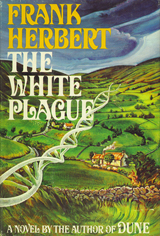
White Plague - Frank Herbert

Frank Herbert is one of the best authors of all time, not just science fiction. And if you need any proof of this, I’d recommend a fairly non-sci-fi book like this. It covers a massive range of issues, from morality and religion to violence and war, science and politics and of course, the ever interesting “what-if” doomsday scenarios.

There’s also a range of characters, predominantly American, Brits and fucked up Irish. And not the great, St. Patrick’s Day everyone wearing green and listening to U2 or Dropkick Murphy’s Irish, I’m talking about the real Irish. The ones who are violent, hateful dickbags with a penchant for getting under people’s skin and holding grudges with them until the end of the world looms near.

But through all the violence and hatred, Frank Herbert has a way of conveying the heart of the issue without actually writing anything of the violence. You just hear about it after it has already happened, it is really quite brilliant. The very beginning is the only time in which violence is described in detail, and that is what sets off the entire plague.

An American (of Irish descent) in Dublin loses his family courtesy the IRA and basically goes batshit. He spends the next stage of his life retracting into a home-made basement laboratory creating a disease that will kill women. All women. So that Ireland (the place he lost his family), the source of their extremists’ weapons (Libya), and the source of their pain (Great Britain) will know his despair when their women parish. Scientists and politicians from around the world unite to find a cure, or even just to know what is happening with this disease. Women in quarantine are held in captivity against their wills, and are unsurprisingly targeted by the lonely, mad male population. But of course, being raped by a man who is a carrier (with no way of knowing if he is a carrier or not at this point) will only kill you later on anyway. Eventually the same united scientists/politicians begin to suspect who may find the cure first and use it as leverage to become a superpower, or who may use it to protect their women and call for others as there is about a 10,000:1 ratio of male to female on the planet.

So there is unrest globally and within the groups fighting for a cure. There is also a new pope because the previous one had a heart attack as the Catholic Church is blamed by so many for their ties to the Irish and the violence in that country. This loose end is tied just enough to talk about how the new pope is assassinated because he’s fucking crazy. But in typical Herbert fashion, this isn’t a failure of religion, it is a failure of bad politics. The religion is actually a huge part of the antagonist’s soul-searching, as he is teamed with a Priest and a devastated boy to a firsthand viewing of all his damage. Then there is the asshole Irishman, starting shit and beating the Priest on occasion, coming on way too strong and making himself an opponent of not only religion, but the quest everyone is on to make it to the labs and work towards a cure (which, also in typical Herbert fashion, isn’t really what’s happening).

I also freaked out, healthwise, when I read this book…seriously. I jotted down the following passage as I crossed the quarter mark of the book:

I did realise in the early goings of reading this, though it is very terrifying and well written, I am possibly too much of a hypochondriac to read about plagues, outbreaks of disease and biological warfare. There's a couple chapters; one in which Herbert explains the creator of the disease's reaction to it, catching a stray from the lab I believe he calls it, and is overcome by less-than life threatening but still serious symptoms. In the next chapter we learn the symptons first hand from a lady intent on explaining to scientists/doctors exactly what is happening to her as she loses everything. The symptoms begin to make me nervous, and all of a sudden I'm consciously aware that, on some minor scale, I share some of these symptons with her. For example, as she's lying on her deathbed recalling everything that she has noticed lately that was even slightly different, she mentions she woke up horny, very horny. Hey, I was really horny this morning, I thought. And she follows this up by explaining how hungry she was in the morning, ate two breakfasts. Hey I could have eaten two breakfasts, I was that hungy! She goes on to mention the headache, which was no doubt similar to the one I had (and I forgot as I was reading at the time that mine was due to dehydration and alcohol consumption the prior night). Then it's the current symptoms, elevated heartrate (Oh no, my heart is beating faster than normal too), sweating and feeling cold (I think I just got the chills myself!) and dizziness (Wait for it...this is the feeling I usually get before a wave of dizziness comes. Holy Mother of God, he got me! John Roe O'Neill got me! The sonnovabitch!). But like a crazy person with a message to send as the world ends and fades to black, I hear my conscience, the voice of reason inside my head, running against the current of destruction and trudging through the rubble, arms waving and screaming to get my attention. Shouting all the while "It's not real! It's all in your head, you actually feel quite fine." And when I hear this I realise I do actually feel quite fine, and I'm not going to die of a disease Frank Herbert made up in a basement in Seattle....though, suspiciously enough, I was reading this book the same time I was in Seattle, and about the same time I'd had medium-rare pork for the first time.

So yeah, hypochondria, it'll ruin anything I'm reading about human health, disease and illness you can think of.

Anyway, if you have time to read a doomsday book, or like Sci-Fi authors bridging the gap into more of a thriller role of fiction, or just hate the lousy Irish (I am very Irish for those of you who don’t know me, so I feel fine talking this way), then I recommend this as one of the best late-Herbert books out there.