The second half of the book is where
things pick up and the plot really develops. For Roland and his love affair
with Susan, things get passionate until they reach a hot, sweaty climax typical
of western romance stories. For him and his ka-tet, however, things get super
badass as they morph into gunslinger mode. And for the town of Hambry
and indeed all of Mejis, things twist themselves into a murderous, maddening
rage similar to what we saw in Book I with the town of Tull going nuts and
Roland having to go full Cormac McCarthy on each and every man, woman, and
child in that town.
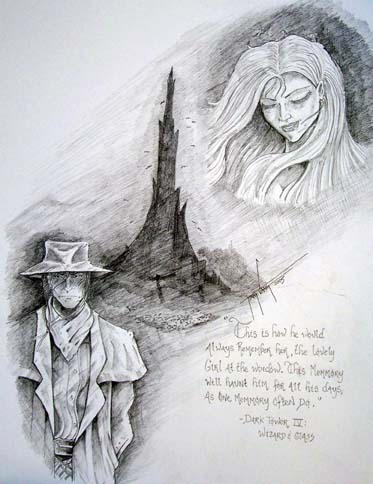
No one is safe. The sound of the
thinny is a constant reminder of the serious peril that lies just outside of
town, and the witch that Roland deals with in order to protect his lover
becomes obsessed with avenging the death of her snake/toy. People are going to
get hurt; it is just a matter of when and where.
What I admire most about this book
is how it is done, not so much what happens. King’s take on the game Castles,
wherein you keep yourself disguised until you are ready to attack and come over
the hillock, thus exposing yourself yet hoping you have enough momentum to
impose an unbending will on the opponent, is a fictional game that is a perfect
metaphor for what the ka-tet is doing with Jonas’s Coffin Hunters. After
some minor peaks at each other’s offensive capabilities, Jonas makes a move and
destroys the boys’ guest house. Roland isn’t biting. He feigns complete
ignorance, a guise they work well under, until they are captured, arrested and
jailed for the deaths of the mayor and his right hand man. Murders that were
actually carried out by the Coffin Hunters. This is their “all in” and
aggressive attack in the game of Castles. Too bad for them, Roland is
game.
After Susan breaks them out of jail
we get our first look at the real gunslingers. And my goodness is it awesome.
The final 2 days of the season, the Reaping Festival under the Demon Moon, are
the most significant, action packed, bloody and tragic. But it is not just what
is going on, again, that is my favourite part. It is admiring the universe King
has created, that I enjoy most. The seasons, the Demon Moon, its effect of
putting people into a trance, bringing out their rage, all the while shining
down on them like an evil, bloodthirsty god. It is so brilliant.
Many sci-fi and fantasy authors have
created unique universes, sure. Isaac Asimov and Robert Silverberg’s Nightfall,
for example, involves a planet with seven suns and a never-before-seen moon,
and as people study the skies in constant daytime they contemplate the impact
the sky has on them, and how terrible it could all be if their stars (suns in
this case) were to align themselves in the ever-so-rare fashion that brings
about an unrecognizable change. Meanwhile, fantasy books like The Kingkiller
Chronicles or The Belgariad Series have fantasy worlds celebrating
different seasons than ours but something we still recognize: growing seasons
(summer); harvest (autumn); dark, cold dormant seasons (winter); and times of
rebirth (spring). But I don’t feel like anyone has captured it all, the
ominous skies, the parallel seasons to ours, the wickedness you would expect
from a demonic autumnal post-harvest celebration (Halloween, anyone?) quite
like Stephen King has. Everything about it is worked out so well, so meaningful
is each and every variant of the phases the Moon goes through. And I love how
it crashes violently into the wild nature of people saying goodbye to the most
lively, productive part of the year. Queue the insanity.

The Wizard’s Glass is another fine
touch in this story, too. It is pretty much directly responsible for Roland’s
threats to the witch, the capture of Susan, his loss of youth, the quest for
the tower and several other horrible crimes he commits after he leaves Mejis.
And it reappears, Wizard included, to issue more warnings to Roland and his new
ka-tet of Susannah*, Eddie, Jake, and Oy. The Wizard is powerful, yes,
but vulnerable, we see. After all the drama, Roland has apparently lost himself
only to have the ka-tet bring him back to his senses. They are not
breaking up, there is no going back, and they will all push on towards the
Tower. A great continuation of the series, in my mind.
*Author’s Note: Can I just say (oh of fucking course I can! This is my blog, what am I drunk? Who prefaces statements with that other than drunks?), in a
quick, unrelated, side-bit about Susannah, that as much as I absolutely despised
her as a character when she was first introduced, mainly as Detta Walker, that
I now enjoy her equally as much, if not more so? Not because of a monumental
change in character, but because she remains an artistic rarity. Think about
the character she represents: confused, multiple personality disordered, racist
southern black lady who may be handicap yet is still as capable as a
gunslinger. But in terms of modern pop-culture black protagonists, she is quite
the opposite of what we’re used to. Django Unchained, a very unoriginal and
uncomical take on comedy legend Blazing Saddles, tells a story of one
African American’s revenge on a greedy, slave driving white frontiersman.
Stephen King could have used Odetta Holmes/Detta Walker as his contemporary of the
year-2013-cliché-racial-allegory-to-promote-white-hate-crime-comitting-awareness.
Yet he did not. Instead, he uses her as an example of how horrible one person
can be, driven by racism, and yet how they can overcome that, gain hold of
their senses, and turn into a leader and key contributor to a small group on a
very important mission. Almost making it as though whichever side of the
1960’s/1970’s race war she is on, completely irrelevant. And for that, I give
Stephen King mad props. Because it seems it is just way too easy for people to
in Hollywood and pop-culture these days to say “here’s a colored person who is
showing outrage to illustrate how hateful/corrupt/racist white people are,
let’s watch it happen and talk about how brave this person of color is, but
only if the white people fail miserably and/or die.” Stephen King brings an
element of not really giving a shit about colour, only pointing out that
extremists lose sight of what is really at issue. But they can recover, and
redeem themselves. For that, I tip my hat to you, Mr. King.