Popular Posts

Showing posts with label Epic. Show all posts

Wednesday, August 28, 2013

Wizard and Glass - The Dark Tower: Book Four (Part II)


The second half of the book is where things pick up and the plot really develops. For Roland and his love affair with Susan, things get passionate until they reach a hot, sweaty climax typical of western romance stories. For him and his ka-tet, however, things get super badass as they morph into gunslinger mode. And for the town of Hambry and indeed all of Mejis, things twist themselves into a murderous, maddening rage similar to what we saw in Book I with the town of Tull going nuts and Roland having to go full Cormac McCarthy on each and every man, woman, and child in that town.
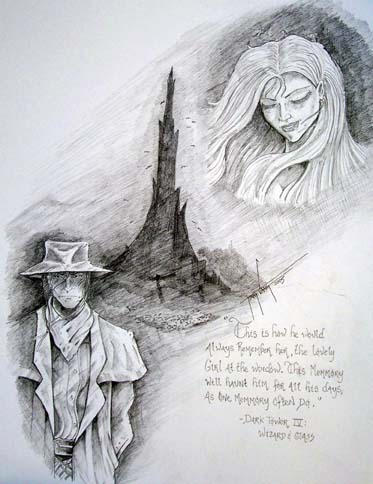
No one is safe. The sound of the thinny is a constant reminder of the serious peril that lies just outside of town, and the witch that Roland deals with in order to protect his lover becomes obsessed with avenging the death of her snake/toy. People are going to get hurt; it is just a matter of when and where.

What I admire most about this book is how it is done, not so much what happens. King’s take on the game Castles, wherein you keep yourself disguised until you are ready to attack and come over the hillock, thus exposing yourself yet hoping you have enough momentum to impose an unbending will on the opponent, is a fictional game that is a perfect metaphor for what the ka-tet is doing with Jonas’s Coffin Hunters. After some minor peaks at each other’s offensive capabilities, Jonas makes a move and destroys the boys’ guest house. Roland isn’t biting. He feigns complete ignorance, a guise they work well under, until they are captured, arrested and jailed for the deaths of the mayor and his right hand man. Murders that were actually carried out by the Coffin Hunters. This is their “all in” and aggressive attack in the game of Castles. Too bad for them, Roland is game.

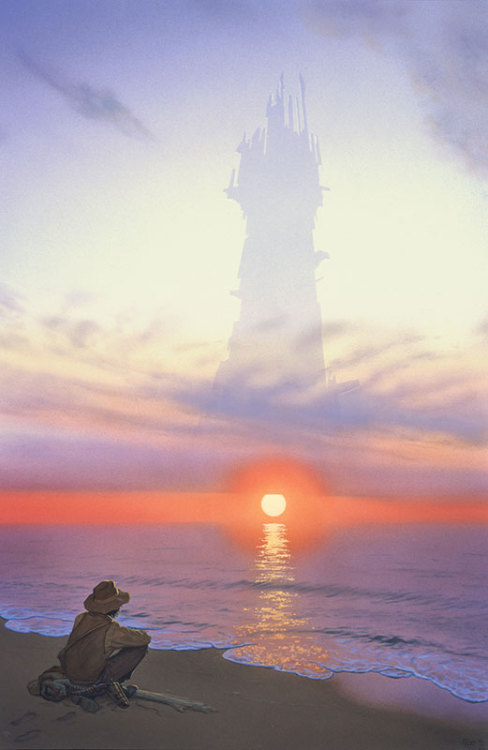
After Susan breaks them out of jail we get our first look at the real gunslingers. And my goodness is it awesome. The final 2 days of the season, the Reaping Festival under the Demon Moon, are the most significant, action packed, bloody and tragic. But it is not just what is going on, again, that is my favourite part. It is admiring the universe King has created, that I enjoy most. The seasons, the Demon Moon, its effect of putting people into a trance, bringing out their rage, all the while shining down on them like an evil, bloodthirsty god. It is so brilliant.
Many sci-fi and fantasy authors have created unique universes, sure. Isaac Asimov and Robert Silverberg’s Nightfall, for example, involves a planet with seven suns and a never-before-seen moon, and as people study the skies in constant daytime they contemplate the impact the sky has on them, and how terrible it could all be if their stars (suns in this case) were to align themselves in the ever-so-rare fashion that brings about an unrecognizable change. Meanwhile, fantasy books like The Kingkiller Chronicles or The Belgariad Series have fantasy worlds celebrating different seasons than ours but something we still recognize: growing seasons (summer); harvest (autumn); dark, cold dormant seasons (winter); and times of rebirth (spring).  But I don’t feel like anyone has captured it all, the ominous skies, the parallel seasons to ours, the wickedness you would expect from a demonic autumnal post-harvest celebration (Halloween, anyone?) quite like Stephen King has. Everything about it is worked out so well, so meaningful is each and every variant of the phases the Moon goes through. And I love how it crashes violently into the wild nature of people saying goodbye to the most lively, productive part of the year. Queue the insanity.

The Wizard’s Glass is another fine touch in this story, too. It is pretty much directly responsible for Roland’s threats to the witch, the capture of Susan, his loss of youth, the quest for the tower and several other horrible crimes he commits after he leaves Mejis. And it reappears, Wizard included, to issue more warnings to Roland and his new ka-tet of Susannah*, Eddie, Jake, and Oy. The Wizard is powerful, yes, but vulnerable, we see. After all the drama, Roland has apparently lost himself only to have the ka-tet bring him back to his senses. They are not breaking up, there is no going back, and they will all push on towards the Tower. A great continuation of the series, in my mind.

*Author’s Note: Can I just say (oh of fucking course I can! This is my blog, what am I drunk? Who prefaces statements with that other than drunks?), in a quick, unrelated, side-bit about Susannah, that as much as I absolutely despised her as a character when she was first introduced, mainly as Detta Walker, that I now enjoy her equally as much, if not more so? Not because of a monumental change in character, but because she remains an artistic rarity. Think about the character she represents: confused, multiple personality disordered, racist southern black lady who may be handicap yet is still as capable as a gunslinger. But in terms of modern pop-culture black protagonists, she is quite the opposite of what we’re used to. Django Unchained, a very unoriginal and uncomical take on comedy legend Blazing Saddles, tells a story of one African American’s revenge on a greedy, slave driving white frontiersman. Stephen King could have used Odetta Holmes/Detta Walker as his contemporary of the year-2013-cliché-racial-allegory-to-promote-white-hate-crime-comitting-awareness. Yet he did not. Instead, he uses her as an example of how horrible one person can be, driven by racism, and yet how they can overcome that, gain hold of their senses, and turn into a leader and key contributor to a small group on a very important mission. Almost making it as though whichever side of the 1960’s/1970’s race war she is on, completely irrelevant. And for that, I give Stephen King mad props. Because it seems it is just way too easy for people to in Hollywood and pop-culture these days to say “here’s a colored person who is showing outrage to illustrate how hateful/corrupt/racist white people are, let’s watch it happen and talk about how brave this person of color is, but only if the white people fail miserably and/or die.” Stephen King brings an element of not really giving a shit about colour, only pointing out that extremists lose sight of what is really at issue. But they can recover, and redeem themselves. For that, I tip my hat to you, Mr. King.
Wednesday, April 10, 2013

Wizard and Glass - The Dark Tower: Book Four (Part I)

That Part I bit in parentheses is due to the fact that I wrote so much to this book, I wanted to share it in two parts. Oh and I sort of read it in two parts, breaking midway through (which this review covers, obviously) to pick up a book for our Book Club, the CBC, which was Nation (reviewed last month).

We join Roland and the gang right where we left them at the end of Book III; aboard Blaine the Mono hauling ass through the Waste Lands at an incredible rate of speed. Blaine is a psychotic self aware and extremely violent computer system on board the at-one-time state of the art monorail, and enjoys riddles even more than he enjoys slaughtering everyone within the city of his resting station.

Thus far the series has evoked villains from so many different backgrounds it is difficult to expect anything but the unexpected next: old west druggies and undead folks; a crazed religious figurehead that turns to an extremist leading a deathgroup; zombies at the way station; a mysterious wizardly man in black; demon-fairies and just straight up demons; Jack Mort the insane violent psychopath in contemporary New York City; Guido Druglords; giant evil venomous lobstrocities and their lawyering questions; A giant bear that is actually a robot with some sort of disease; a plaster man that jumps out of the walls of a haunted house and eats people; and some wackos within the city in which Blaine the Mono reigns, unbeknownst to the wicked ruler we only know as Tic-Toc. Not to mention the monsters that the gang sees on their way through the Waste Lands.

That being said, this universe is very fucked up. Stephen King is a very cynical writer and most characters are either terrifying to imagine or just plain twisted. Everyone thinks of some pretty nasty stuff on occasion, but we maintain that we are mostly normal. The characters thus far, though, seem to be composed entirely of the very things we find repulsive in one another or, worst of all, deep within ourselves. Which is what I like about King and what I really like about the series. Not a lot of good people, not much in the way of innocence and sure as hell there is nobody who is remotely innocent here that doesn’t get side-swiped by some unfortunate turn of events.
Stephen King is also a man with children in his stories. Nearly every book I have ever picked up of his, save maybe 1 (Misery I think?) has a child character or a scene where a character is flashing back to being a child. And he loves cashing in on the discomfort of growing up, and also of being afraid. So after Eddie, against all odds, bails the gang out with nothing other than quick wit, silly New York humour (i.e. dead baby jokes), and a face melting explosion of shit talk, Roland is faced with the difficult task of regaling them with the story of Susan, the woman he oft refers to in his incoherent mumblings.
I mentioned it just now but I have been drinking so I will say it again, before we get side tracked with the legend of Roland, Eddie Dean’s trash talk is a truly magnificent piece of this series. Everyone has a weapon in life. Some people throw their weight around, some are gunslingers, some are quiet and polite but are real killers underneath with a quick hand and a lethal touch. Eddie Dean is a man I can relate to, though. His weapon is his mouth. His big fucking idiotic mouth. Issue him a challenge and the fight is over before it even begins, literally, as it probably will not reach the point of fighting since people like him are the sort than can break a man (or machine, mind you) down with harsh language so effectively that everything the challenger hates about him, he is brought to see in himself and absolutely loses his mind, composure, and all ability to maintain the upper hand. I dig that.
Back to the Legend. Roland sets the stage with this young hottie Susan real well. We are transported to another world - or another where and another when, in this series - and it turns out this one is a Western with a small Western-like town and a witch just outside. The witch is pretty nasty, truly vile in the Stephen King sense but also a bit comical, as she is quite terrible at being a witch at her old age. I really like the setting, especially as we learn more about it. Not just a Western, but a post-apocalyptic Western where some of the carryover from a world we might recognize (oil fields, tankers, refrigerators) make appearances but there is mystery as to how anyone could make honest use of them. The references to mutants amongst the horses, cattle, and pets gives the reader more hints at this universe, lending more to the debate of “our world that was split by nuclear warfare, or just a fantasy world that is similar to ours and then split by nuclear warfare?” Bog (and King) only knows.
It is better to just sit back and let the worlds unravel themselves. And pay attention to the hot broad that catches Roland’s eye. Teenage Roland, that is. And even a complete badass like him, the youngest gunslinger of all time, needs to have a good alibi for fucking the holy Christ out of a tragic young blonde like Susan Delgado; so he says it is Ka. “No, no, don’t get me wrong, I don’t want to do these awesome things to her, I just have to. It’s Ka!” (not an actual quote from the book).


This is also our first real introduction to the character from Roland’s youth that we have come to learn is much like Eddie Dean, Cuthbert Allgood. The kid is a phenomenal character. Always talking, like Eddie, always trying to make a joke, and never at an appropriate time. And really, all Roland wants is for him to shut up. But the kid also has talent. He can talk his way out of a jam as easily as he can talk his way into it. Plus, he is a killer just like Roland. Very understanding of the ways of a gunslinger, even if he has not passed through his rite yet. Also a bit of a jealous bone, which makes him very human but very much the identifiable young, envious, right-hand-man to Roland’s young alpha-male group leader personae.

Sunday, April 8, 2012

Doctor Zhivago


Well I thought I’d go Russian, again, for a chance to get my feet settled back on familiar hard ground. Hard, unapologising, unrelenting and completely unforgiving ground. Doctor Zhivago is a tale of…love? No that’s not quite right. War? Famine? Revolution? Journeys through the dark, lonely unknown to discover that ultimately nothing in life can bring you happiness? It is all of those things, but even more.

One of the most incredible books I have ever read, and I don’t always say that even about books I like. I have never come across a character so conflicted, from so many different facets of a life full of despair and unfair disadvantages. Even second chances are cruel to the antagonist.

I have read of characters that have perhaps more severe conflicts and sources of torture: Orson Scott Card’s Ender Wiggin, Frank Herbert’s Paul Atreides, Nabokov’s Edgar H. Humbert, Dumas’s Edmund Dantes, and so on. But no one has so many converging ideals and changes of belief, changes of heart from warring sides than Doctor Yury Zhivago.

Raised without a father – who committed suicide after losing his wealth and being misled by a conniving laywer – Yury rises through a dangerous Moscow to eventually become a member of the bourgeois class after attaining a medical degree. He sympathises with the working class’s ideals, however, being very much in touch with the heart of Moscow and realizing how unfair the current system can be.

But after traveling to the front lines of World War I, his ideals begin to shift. He no longer thinks violence should be used to convey a message, and that there are no ideals strong enough to warrant the taking of innocent lives.  And when he returns, he is appalled by the violence of the October Revolution and flees with his family and father-in-law to a small town in the Urals. Did I mention the Mother-in-law didn’t make the trip because she dies a miserable death early on, tortured so much by her past with the yet-unconnected but exact same conniving lawyer who has influenced Yury’s life? Well despair overtakes her and she tries killing herself with lots of poisons, but Yury saves her life and gives her a few more dark, depressing years.

Now that the remaining happy family has survived World War I, the February and October revolutions, they make their way out of Moscow to live on their own in the Urals. Along the journey Yury meets and deals with desperate people on the run, similar to him, as well as soldiers fighting for causes some feel passionately enough to kill for and others aren’t so sure, and become deserters even at the threat of the death penalty for these actions. Once in the Urals Yury rekindles an old flame with Lara Fyodorovna, wife of a Pavel Antipov and neighbor/acquaintance of Yury’s growing up Moscow as well as a nurse he came to know and admire and, secretly, love during their time together in hospitals near the frontline in WWI. Lara had tried to pursue her run-away husband who left her because he felt he didn’t deserve her and sought to gain renown as an infantryman, fighting gallantly to defend, and in the near future help reform Russia.

The plot thickens as Yury develops an affair with Lara, and before he comes to terms with admitting to his wife Tonya what has been going on, he’s captured by the “Forest Brotherhood,” a guerilla fighting force led by a cocaine-addict that is actually a separate entity from the Red Army, but still fighting viciously against the Whites. Forced to treat people fighting for a cause he doesn’t support, Yury begins to lose taste for his profession, especially after being pinned down by White Army cadets (which is a nice way of saying teenagers with guns fighting for the cause he does support) and forced to take action and shoot at them in order to escape. He begins to contemplate leaving the Forest Brotherhood, which is risking his own life, because of the conflicts he feels being a medic for a Red-sympathising guerilla force.

But of course, these mixed emotions about the ongoing conflict just aren’t complicated enough. So the Whites throw in an extra element when they torture a man by removing one arm and one leg and force him to crawl through the forest back to the Brotherhood’s camp. There he tells them of the unimaginable horrors in store for them all as the Whites begin to close in on their region.

Strelnikov, a displaced Pavel Antipov who is now a former POW with a new name and blood lust for White Army soldiers, ends up breaking through and the Reds move on to victory after Yury escapes from the Brotherhood. He’s no safer in public now, however, and must keep a low profile, abandoning a force fighting against the Whites in time of war is reason to face the firing squads in this time, and after he learns that the Soviet government now looks unfavourably upon the Forest Brotherhood, likely for being too independent, he has no one he can trust. Even Strelnikov falls out of favour with the Soviets (as his mysterious and charismatic nature gained him loyal followers, he also gained the attention of the Communist Party as a potential threat moving forward) and is on the move, all alone, much like Yury.

The two of them meet, whilst both in hiding, and after Yury tells Strelnikov that Lara is as inaccessible to him as his estranged wife Tonya (now living in exile in Paris with their kids and her father), Strelnikov shoots himself. Of course he does. Yury winds up making an attempt to salvage his life as a poet and translator in Moscow, living the slums, taking a wife, having children and then leaving her too and eventually suffering a heart attack on the streets. Lara makes it to his funeral and is later arrested and put into a Gulag, a sort of concentration camp in Siberia Stalin was very fond of using.

The story ends with Zhivago’s friends, Dudorov and Gordon, talking about how they survived the Gulag’s to become WWII servicemen, as well as talk of a young girl named Tonya who very much resembles Yury and Lara and the physical/personality traits by which these two came to associate them.

Needless to say, Boris Pasternak was in deep shit with the Soviet Union, Stalin, the KGB and Writer’s Soviet when the book leaked out of the USSR and was printed in several other languages before the USSR ever authorized its publication in Pasternak’s homeland. He was also “encouraged” by the KGB to decline the Nobel Prize for Literature he won that year.

I think people of my parent’s generation are much more familiar with this story, as the movie was a huge hit when it came out and everyone at the time was a big Omar Sharif fan. But for my generation, I think this book goes largely unnoticed. And I can’t see why. There are probably too many lists out there of the top 100 novels, or top 100 modern novels, or any essential book collection, and Doctor Zhivago doesn’t seem to be prevalent enough on those lists. There is no reason it should ever be placed outside of the top 25 on most of these lists. But, we do live in America, and most people can’t handle this much conflict.