Popular Posts

Showing posts with label Humour. Show all posts

Tuesday, May 14, 2013

Another Roadside Attraction

Here’s the review of that one. We have all read it, surely. It was a CBC book after all. And we all discussed it at the meeting on the 27th of April. So I got to say what I had to say about it there, which differed greatly from the other(s) who had read it and others who are yet to. This is my chance, however, to have the last word, and say what I liked about the book at a louder volume and, perhaps more importantly, immediately after he/she/those who opined it was a meh book; to have a last word that will seal this book’s legacy forever.

It was good. Pretty damn good, in fact. Not as a book, and certainly not as a novel, but as a read. Humourous, odd, hippie-ish, dry, and minimal in its jokes’ punchlines, yet cultured and well-rounded enough to be appreciated by those with a taste that has ever had anything in common with the target audience (i.e. dirty Pacific Northwest hippies). For a guy like me, brought up in the desert and a University of Arizona graduate (a character in the book is likewise an alum) with a pretty thin, yet surprisingly strong (like the root of a mesquite tree in its infancy), connexion to the Pacific Northwest and all it has to offer – naturally, industrially, artistically, fundamentally, and spiritually – this book’s author seemed to be a man after my own heart. Not sure I like that phrase, but people know what it means and I cannot think of one that replaces it that people will automatically recognize.

To begin with, the girl in the story is a character I can fall in love with and not love, and I feel like she would be perfectly fine with that. She is a magical flower-child with a beauty that is not to be paralleled and a complete disregard for social norms. Not that I have a thing for flower-child granola bitches, especially those that do not shave their pits and think my hunting/fishing is somehow cruel, but everything about the girl’s personality just sounded generally fun. She also copulates. Frequently. At a Robert Heinlein character sort of pace (that’s the guy that delivers the quote I love: “Better copulate than never”).

The book’s magician is a guy named John Paul (of course his name is John Paul) Ziller. He has a baboon named Mon Cul. This turns into a bit of a fable at the end, which is really the only part of the book that resembles a plot and a storyline and a premise and a conclusion/resolution. It also kind of reminds me of Karl Pilkington’s Monkey News /OOOooh! CHIMPANZEETHATMonkeynews…. (TM Ricky Gervais)


The magician’s friend is an athlete who used to play football for Duke University and can still beat the hell out of anyone, and his mishap in falling into a violent order of monks within the catholic church is also a plot-line that really ends up being the chief storyline and the reason everything unfolds the way it does. And it is bizarre. But funny, at least to me.

Then there is the interesting bit about the narrator. He has experienced some of the story of which he writes, he is currently writing in a state of crisis as the story has not completely unfolded, and the story finishes with him recapping everything and bringing you to date in his current, hellish situation. Which reminded me a bit of the style in which the narrator recaps events in Pale Fire, the book that inspired me to finally get this blog going. If you decide you might be into stories that are written in that odd, rare, fictional-memoire-yet-present-tense-at-the-end form, you may also enjoy A Time of Changes by Robert Silverberg.

Another thing I would like to say I found enjoyable in this one is just how much use the characters believe there really is in a roadside attraction. It reminded me of two books I have read that have heavy inputs from roadside attractions: American Gods by Neil Gaiman – a book about varying forms of mythology taking on what people in today’s world worship; and Driving Mr. Albert – a non-fiction book my brother recommended about the improbable cross-country trip of Albert Einstein’s brain as it was returned to his family by a somewhat comical coroner who almost resembles a janitor.

That may just be all I have to say on this book. Unless someone else still has something to say about it, in which case I will respond to that and make my comment the final say and that will be that. Pretty odd book, overall, but I liked it.
Thursday, March 7, 2013

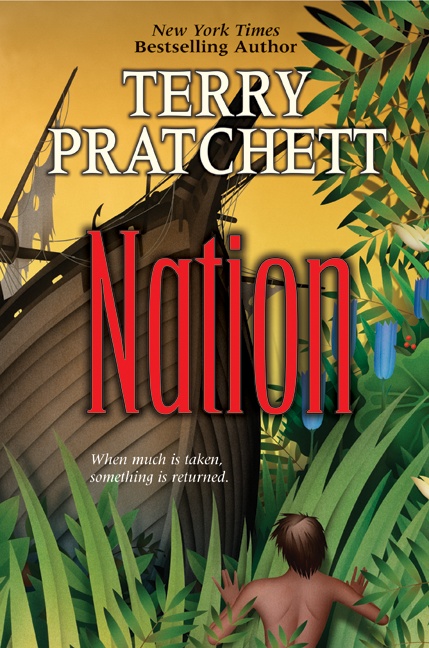
Nation - by Terry Pratchett (it's funny)


Nation is a good story. Humourous, adventurous, insightful. It brings together, in times of great human tragedy, a native islander boy on a very isolated South-Pacific-esque island in the fictional Pelagic Ocean (brilliant touch) and a woman of high British society, the nobility, the class of people that work their way into many books I read and I really enjoy them.

I picked this book up in the middle of reading Wizard and Glass, book IV of the Dark Tower series, so I was feeling epic and dark. Not really in the mood for such a light read, but I won’t hold it against Terry Pratchett. His humour is relentless, consistent and puts a smile on my face throughout the book.

Mau, the protagonist, returns to his home island after being sent out on a rite of passage, arriving just after a catastrophic tsunami washes away his entire home civilization. He is met there by a shipwrecked Lady, named Ermintrude but decides to go by Daphne instead. Very much an upgrade. Anyway, the first part revolves around the integration of two completely opposite cultures learning to survive on an island, all whilst Mau fights his own internal battle with the Grandfathers, a religion of sorts amongst the islanders, whom he blames for the deaths of everyone he has ever known and loved, and further struggling to follow the traditions that helped build his Nation and ensure their survival but denying other traditions that seem pointless now. It makes for great internal conflict, and the fact that the two parties are so poor at understanding one another, seeing eye to eye, things tend to get solved more by rationalizing than by clinging to traditions. Traditions only go so far for Daphne, who is from high British society but shipwrecked with only an islander as her companion; and Mau as well, who feels that traditions failed to protect people from the horrors of mother nature.

Pictured: Terry Pratchett's teeth, beard and novel.
Smoke signals are sent out, by means of a continuous bon fire, and people from nearby islands begin arriving. Soon enough there is a new Nation being built, led by a young man who is named Chief very unconventionally, not having gone through the official rites of the transition from boyhood to manhood usually granted to people who pass the test that Mau indeed passed.

When mutineers-cum-pirates from Daphne’s ship, the Sweet Judy, find their way to the island and threaten violence, the Nation and Mau stand strong. And it isn’t until her father, crowned as King by virtue of everyone dying to some epidemic of influenza, rescues them that we see Daphne’s struggles fitting back into British society. One Western party arrives on the island to use brute force and take it over, and claim the white girl of course, whilst the other comes to plant a British flag and claim the island as a new port, as well as to bring the girl back to high society, albeit in a more peaceful, civilized manner. Both are wrong, and both are made to see the error of their ways, yet Daphne still returns to the place where she can be of more use to the islanders, helping set up science foundations that study the secrets that the island beholds, most notably its ties to early man and the first conquests of the world.

I believe it is a clever book, set in a cleverly made up South-Pacific-like fictional place in an alternate history universe. The people develop as we’d like to see people develop, breaking senseless traditions in the name of progressing as a young nation, discovering science, history, and other cultures with the help of the dominant, ever well-funded and supplied Royal Kingdom. One of the better light reads and, as always with Pratchett, very funny in many places, even if his humour is a bit exhausting at times.

Tuesday, October 9, 2012

John Dies at the End


Good news everyone! It's a fucking movie now, so you don't even need to read this book!

The first thing I realized about this book is that it is funny. Not like, here is a shitty joke, or that character has a weird tweak, or the idea that monsters and demons are just like bullies, sort of funny. I mean full on f***ing hilarious. If you have a dark sense of humour, think exploding people and goofy spiders with little hands and fake wigs could be funny, combined with the absolutely strange intuitive near-superpowers of demon slaying kids who are basically f***-ups and a guy who loves to deliver cheesy one-liners before he blasts monsters, then yeah, this shit is really great.

I can’t speak too much of the plot, because I think it is actually quite messy and not very good. The fact that it bounces all over the place only to be tied in all together at the end is cool, but nothing unique and leaves for a lot of unanswered questions in terms of how and when things took their turn into the alternate reality or crossed-universe that the narrator, and the reader by the end, are familiar with.

But my goodness, weak, discontinuous or fragmented plot slopped together or not, this book is full of great moments. So much so that I honestly laughed out loud, in real hearty gutlaughs, and it really made me feel like I didn’t care what was happening in the plot at that particular moment; the writing is funny enough to cover the tracks of any literary crimes.

David Wong, the alter-ego of Cracked.com writer – Jason Pargin – is the main character/narrator and has a really great way of bringing a subtle fantasy of monsters and demons into the world of a semi-rational, cynical young bastard. He was troubled as a youngster, and this helps him touch upon actual issues that affect real people, making him a character that’s pretty easy to relate to. Even aside from him calling John a dumbass repeatedly, there is a large amount of angst he holds against humanity. As the story moves along, we learn more about why he was sent to special school to finish his senior year of high school, as he comes clean to Amy about committing the violent crime against jocks that were bullying him that landed him there.

The anti-bullying explosion of his was a very interesting point, I thought. It comes as he learns the truth about Amy, and why he feels bad about noticing her lack of a left hand when John never made an issue of it, and her depression, which actually makes David feel less optimistic about humanity than normal. He reciprocates by telling her of his story, and why he felt he had to do it. Bullies can only push so far before it all collapses against them. There was a moment the book, though funny and not truly very thought provoking, really got to me though. When he finished his spiel on stabbing a bully’s face, and was making a point of how no one should feel bad for those who prey upon kids – kids they feel are weaker in order to get an emotional high from beating them up or making them cry – when the victims fight back with an uncontrolled eruption of psychotic rage, he mentioned a bit about the Columbine School Shootings I had never considered: that the look on those jocks faces when the kids they had bullied had guns aimed for their chests must have been fucking priceless.

So yeah, if you are thinking of bullying someone, please don’t. Especially if the potential victim is a Cracked.com editor.

In all, very funny, very silly and though not a great plot line, carries a bit of a cult sensation to it that I can get behind. I’m happy the author is having it turned into a movie. I will watch it, and whether or not it is any good, I hope he made a serious amount of money from it all.

Wednesday, July 11, 2012

Lamb: The Gospel According to Biff, Christ’s Childhood Pal (a novel)


Long title. Not a very long book considering it covers Jesus’s life from when he is 6 years old through to that point in his life when they made that movie The Passion of the Christ. 31, was it? Whilst not crazy about it, I think overall I really liked it (the book I mean), but of course I cannot just simply say “I like it” or “dislike it” because I am just not cut out that way.

I would say this was otherwise a pretty damn funny book. And the reason I would not say no to a book of this caliber is because I listened to it on Audiobook. I have been doing Audiobooks for a while now and they help break up the nasty, grueling drive I make to reach Phoenix every other weekend to see my lady and on other occasions, hockey team. I keep track for my purposes which of these reviews I Audiobook, and the prior review of The Drawing of the Three I was listening to, a gory enough scene to make me not want to drive listening to it anymore, forced me to turn it off and when I looked up BAM! Car accident. So I switched to humorous books instead, like this one. And well, here is the review of that.

Getting to the meat of the book, this was a very blasphemous story about reviving Levi so he could write a gospel about Joshua (a much better translation of Yeshua’s name) as he spent nearly every moment by his side growing up, through adolescence and into adulthood. Levi, who is called Biff, is an extremely loyal yet crude, unsophisticated simpleton with a foul mouth and a temperament for blasphemy. The story primarily involves their quest for the Three Wise Men at Joshua’s birth, which we learn are a Magician, a Buddhist and a Hindu Yogi. Joshua and Biff spend years with each, and each person teaches him more about how to become the Messiah, whilst he more than masters what they have taught him and in much less time than anyone expects.

Biff, during all this, is helping Joshua by continuing to be an example of what he will never be, a true debauchery fanatic and the only one with vice and terrible qualities enough to bail Joshua and him out of trouble. Most of this is really fun, and when not fun, blasphemous (which is as good as fun, most times).

The twists of what Joshua learns from these people and how it applies to his miracles he performed in the Bible are an extension of the humorous-blasphemy I enjoy. The idea that Jesus learned all that we associate with his mystical side from pre-existing sources by consolidating different aspects of Sun-Tzu, the Bahgavad Gita, Tao Te Ching, Diogenes’’ Cynicism and various other philosophies, is just great to me.

Still, not a great book in my opinion. Felt like it was great when Joshua spends time with the last Yeti, and the jokes that Biff has about that creature, but the end came a bit abruptly and was a bit too unbelievable for my liking. Really, the final scene comes out of nowhere and is completely unnecessary. And what is supposed to be the takeaway from it? That if you serve Joshua as a means to his ends you all get second chances? Unless his other friends didn’t like you? Really the bit about Judas and how it ties into the resolution/conclusion left me a bit confused.

Anyway, if you like to laugh and love blasphemy, it is worth reading, but I do not otherwise have too many great things to say about it. Good enough, I suppose. I will leave you with one last bit of religious history that always makes me chuckle, fan art from an African on Jesus.