Popular Posts

Showing posts with label Kubrick. Show all posts

Thursday, May 3, 2012

2001: A Space Odyssey


Author’s Note: the novel, not the movie

Which is worth noting, as for whatever reason Arthur C. Clarke decided to do both, virtually at the same time. Although I can think of better things to do two of at the same time, he felt that the story needed proper explaining, specifically the Star Gate and the alien intervention, whereas Stanley Kubrick felt that the movie should be mysterious, enigmatic, and move the viewer into a gripping sense of wonder. I like Arthur C. Clarke’s decision more; books are just better and you can draw ultimately the same conclusions with two very different tactics but visually, especially visually as of 1968, I feel like you lose some emotional and psychological unseen aspects that films cannot offer.

That being said, Clarke wrote a very good but not great story, in my humble opinion. I love science, I love space and I love fiction. Anything with space exploration, space treachery, novel concepts of galactic travel, self-aware computers, bizarre ends to interaction with hyper-intelligent creatures and so on, I am all for it.

In fact, I loved just about everything in this book. The symmetry between Moon-Watcher and the Star Child, inheriting powers from the aliens that help shape humanity at the beginning and end of the book, 3 million years apart; great stuff. The will and drive of the cosmonauts to further space exploration knowing their chances of success were terrifyingly low but would stop at nothing to complete the mission; awesome. Even the little things about how physics works differently for them, and with the confinement of the ship and the peril of being alone at the edge of our solar system mounting, their brains are still so well suited that they can work through conflict and keep you interested in their quest to reach Saturn.

I would like to say the only negative of the book was the same thing that usually gets me involved in sci-fi books: aliens. Maybe it is the fault of the creators of the television show Ancient Aliens, but anytime one tries to link humanity’s early advancements with alien intervention (e.g. The Great Pyramids; the Nazca Lines; Stonehenge) there are often silly jokes or strange looks given in response rather than intelligent conversation being sparked. So yeah, alien assistance to shape us the way we are is met with ridicule because it is fairly silly. But Clarke and Kubrick made a really good story about it. And that is not at all what bothers me about this book.

It is really HAL 9000. I guess I have read too much of Robert Heinlein’s self-aware computers (The Moon is a Harsh Mistress with MIKE/MICHELLE/Adam Selene or Time Enough for Love with Dora and Minerva) or droids in stories like The Hitchhiker’s Guide to the Galaxy. But for some reason I simply could not go from a semi-advanced human race in the not-to-distant-future, which 2001 presents to us, to a race with computers that have emotions, feelings, show enthusiasm about completing a mission and ultimately kill humans in the process but with some guilt along the way. They do not fit into the same era, for me.
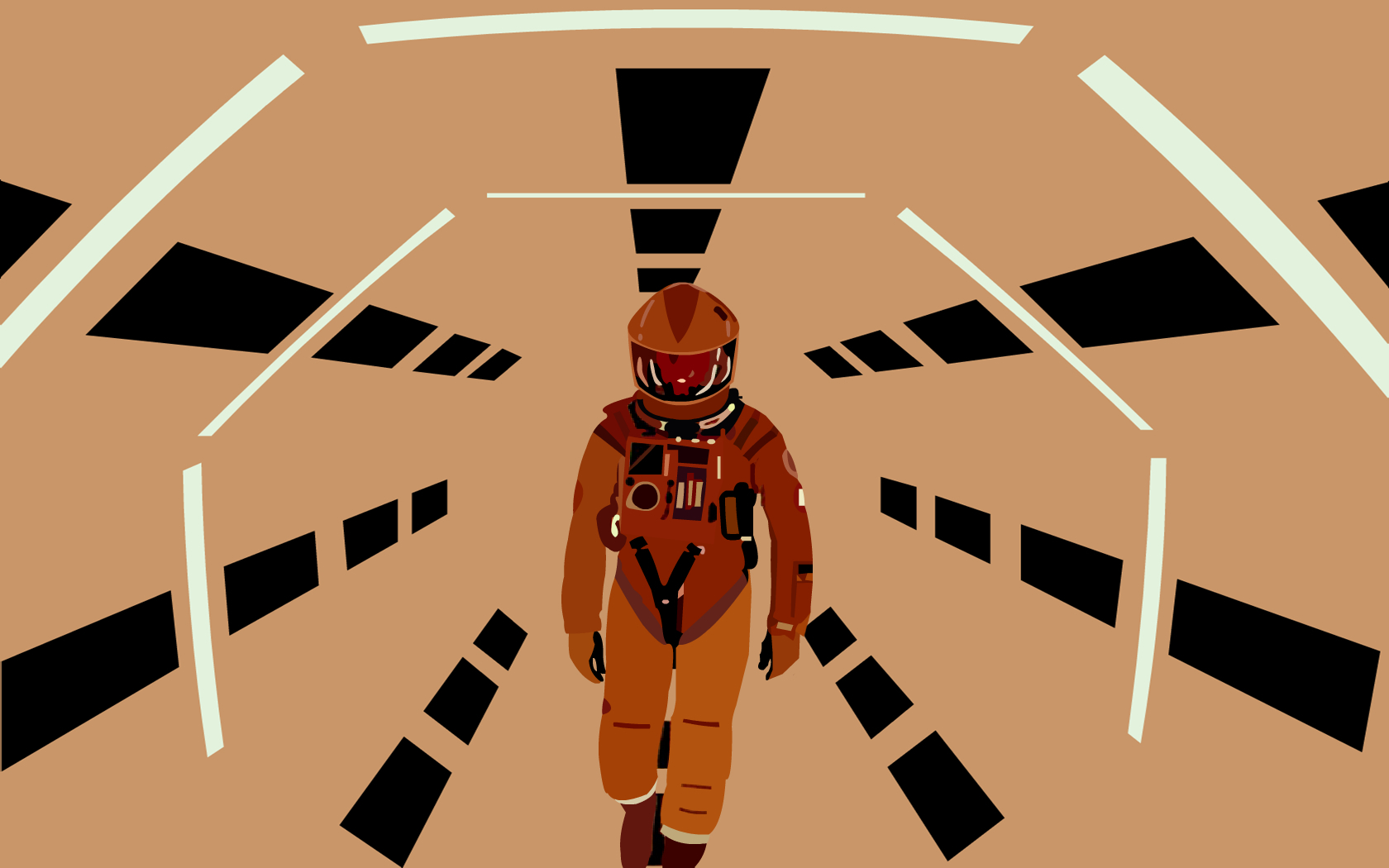


Okay, I get it, there are self-aware computers in this universe. Good, nothing new for me. But why? How? And if we are newly gaining the ability to travel beyond Mars, and newly gaining the ability to have a supercomputer, then give us some insight as to how it came to get a personality.

In The Moon is a Harsh Mistress, for example, MIKE’s personality is gained quite by accident as it makes a computer’s attempt at a joke. Far out, yes, but that’s Heinlein. It is also an error, as in, not supposed to happen and a complete mistake in the computer. In Time Enough for Love, Dora and Minerva are given their personalities, Dora by Lazarus Long in an attempt to remind him of the mortal girl he once loved since she was a child. Sure, it’s sweet, but it is also a design feature.
HAL 9000 just is. And that was a noticeable gap for me that I tried to overcome and enjoy the story, which I did, but just cannot give it credit for being great. The hole that represents HAL 9000 aside, though, everything else is really enjoyable. Even aliens helping us evolve into what we have become (ideas that have since been humiliated by Ancient Aliens. Thanks a fucking lot Ancient Aliens). Going to watch the movie soon, maybe I will let you know how I feel about it. I can already tell you now though that Stanley Kubrick creeps me the fuck out.
Saturday, April 28, 2012

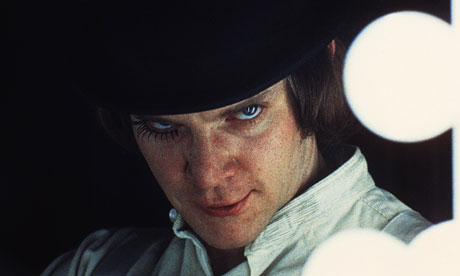
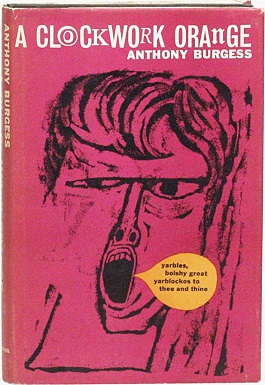
A Clockwork Orange


If you can manage sitting through the awful narration, that is to say Nadsat and all the horrors it brings on sentence structure and half-translations of sentences, then it’s a good book. I compare it to watching a movie in which the camera work is total shit and shakey, like Cloverfield or Quantum of Solace or something really nauseating (I think of this analogy because I recently viewed The Hunger Games and nearly vomited during the entire 2 hours of shit cinematography). Once you are past all that, it is really a good book, very moving and insightful.

Children are assholes, we all know this because we were all children once. But the kids in this book are fierce, terrifying and absolutely out of control. As if I was not put off enough when he destroys a man’s books in the early going, they also assault him and leave him bleeding and crawling, only to move on in the evening and commit a very horrible rape crime that is worked out in details that are not too vivid, and so less violent and disturbing at face value, but almost more horrible because the narrator and perpetrator, Alex, skims along the act and leaves a lot out and it sort of gives you the idea he isn’t all that bothered by it. As though he needs not focus too much on the act because it just is not that big a deal to him. Really terrible.

He moves on to committing a few too many senseless crimes and is later imprisoned for them. Rightfully so. Good, we can all inhale deeply and take solace in the fact that the justice system is doing its work and bad people are punished, learn their lesson and life is good, right?

Alex begins to lose his identity in prison, beginning with losing his name and being referred to only as 655321 during his stay. Sometimes criminals get out on good behavior, but Alex chooses to get out early via the Ludovico Technique, a controversial brain-conditioning program that will reset his behaviours to fearing, terribly, any act of violence or cruelty. His chaplain, whom he is closest too, warns him of the dangers of losing his free will and all ability to choose the proper path, but he ignores it. And just before his procedure, he commits one final act of superior violence by killing the new inmate that is stirring up trouble with the four of them living in their cell.

Alex is released to find himself in a struggle. His family has moved on and so have his old droogs. Though he would like to move on as well, he is still recognized as a menace and not given the chance he was promised to fit into society. One of his old droogs and a former rival are now members of the police and use their power to intimidate, beat and ultimately, rape him. He’s rescued by the man he once met and knows only by two facts: (1) that he is the man who writing A Clockwork Orange when Alex broke into his house and (2) he is the man whose wife Alex and the gang raped. He learns that she committed suicide sometime after that and Alex finds himself as a martyr for a cause that is trying to bring down the oppressive government regime that is responsible for this society being in its current state.

The pressures of it all plus some bad side effects to Alex’s conditioning, brain washing really, force him to attempt suicide and the near-death experience resets his brain and undoes all the washing. So the violent sociopath is back and really gets his way again. In the final chapter – omitted from the early US publication and therefore omitted from the Stanley Kubrick’s film – Alex realizes that he will eventually have a baby and it will grow up to be as big a piece of shit as him, and he will be as powerless to stop it as his parents were to stop him, and so on for generations. I have heard why it was omitted, that many readers would falsely interpret a happy ending, but it really does belong in there. It gives you a sense of how difficult it is to change the culture of a violent group in any society.

So the original British version had a much better ending for me, but the entire book leaves you with a kick in the chest as to how shitty crime evolves amongst misled youth, gangs, gets treated in the prison system and in the end, reproduces. Very desperate feeling to it after it is all over and I dig that.

Lastly, for a little story on how the book was written, check these strange facts out that I found on Tor.com (a favourite website for sci-fi/fantasy nerds everywhere).