Popular Posts

Showing posts with label Russian. Show all posts

Friday, August 2, 2013

Darkness at Noon

I can’t, I mean I really cannot, believe how good some people are at writing sometimes. I know writing is a craft and I have mad respect for anyone who gets a non-Vlad-the-Impaler-loins-fucker book published, but every once in a while you come across authors who can just fucking write. And this is one of them. I have no way of telling you how much I abhor certain political beliefs. I am a Libertarian and Robert Anson Heinlein taught me at a young age that there is no such thing as a Libertarian who is not hard headed and devout in his/her philosophy.

The same appears to be true for Communism, I am learning. That is a political belief I abhor, also. But, I maintain, I can hear a political ideal without immediately having an opinion on it; I can hear someone out and then take time to reflect upon what they are saying. Even still, Communism is difficult for me to grasp. But Koestler’s book is all about presenting to the reader both sides of an extremely difficult political system. And not only does he tell you the sides that are in opposition of each other, he explains the context, to illustrate how a man of reason and logic may fall into a seemingly extreme and violent Party due to the nature of absolute truth and absolute rights and absolute wrongs.

For example, if someone is loyal to the party and works their whole life for improving the lives of everyone, which pure Communism is intended to do, sacrifice individuality for the greater good, but learns later that a (government provided) product is destructive to the greater good and an innovative new product would be better for everyone….that person, scientist, engineer, business owner, political figure, will be liquidated. That is the term used in this history. Liquidated. Probably because “murdered” sounds way too harsh and not quite as productive. Executed would work, but people didn’t have that joy of knowing how well “executable files” work so the word had a very murdery connotation to it. The reason for these happenings is that all majour products that serve the public, by definition of Communism, also serve the state due to the nationalizing of companies who provide majour services for the people (like auto industry, mining, and in the book’s example of this scenario, agriculture). So this person and 30 of his friends find that a product is better than the status quo, says so, and is shot along with all of his friends/coworkers because that technically counts as speaking out against the Government. Against the Party. Against that force that required desperation and extreme, indiscriminant summary justice in order to survive, to have a chance against the Imperialistic White Guard.

Again though, Koestler gives you context, not one-sided views on how great one system could be and how shitty the opposition can be. So there are bits that flash back, bits that involve reflection, and lay out some rather logical steps as to how a man can live with some of the Party’s ideals and even enforce them. Because it was so much better than what they had prior. Because it wasn’t about the ends will justify the means and it wasn’t about one person being in control and setting so firm of rules that one man is dictating the future course of an entire nation, single-iron-fist-handedly. I began to feel bad for Rubashov and everyone that bought into a system that improved upon what they had prior and then turned it into a totalitarian dictatorship, an oligarchy of extreme social equality, to the point of executing those that are different by saying they support inequality.

Is that common? Hunting people who step out of line and either executing them or imposing your will on them such that they have no choice but to conform. I know it happens, on occasion, in our human history. If I read this book in another time period, say, circa 1955, and felt bad for what Rubashov had to go through, I know doubt would have suffered a similar fate at the hands of the most extreme example in our nation’s history – a man with a similar illness with similar goals yet a different political background – Joseph McCarthy. His existence makes me sad for humanity. He makes me think that, due to the fact we as humans did not unite as one to murder his ass, like we would a Hitler or a Stalin, that we will take just about any amount of abuse as long as it is sold to us by a self-proclaimed God-fearing Patriot. Fuck, us. Fuck us. Fuck us all.

This also reminds me, totally book-review-unrelatedly, of a conversation I had with a fellow Libertarian. I am no longer one for labels, so Libertarian, in the sense that Robert Anson Heinlein tried to lead, means nothing more to me now than a lost dream. Like waking up and feeling you were just in possession of something you really desired only to realize the world around you still sucks. Yet a fellow “traveller” (which is much preferred to the oft hunted “fellow traveller”) asked me recently: “When do you think we, as a nation, will have enough? What do you think will be the last straw? What, in essence, will it take, to make the people revolt when it comes to the government overstepping its bounds and doing injustice to the people of this great nation?”


 Too late, I thought. Way, way too late. I paused, I thought further before speaking, would have already happened if we really valued our freedom. Finally, I spoke up: “McCarthy.”  “What?” he said. “McCarthy. McCarthyism, I mean. That whole thing.” He was curious, but as his father walked him to the pickup for their trip home after a hard day’s work, he explained the blemish of our nation’s history to him.

“And Kent State!” I shouted, louder than necessary, just to make sure they would hear me, to be sure there could be no doubt I felt our time has passed. What atrocities. And we just take it. Because getting fucked in the ass sort of kind of in a weird way is a bit cool, I guess. That must be it.

This book took a lot out of my human spirit, knowing how harsh some conditions are. But whatever I read of how horrible some situations are, I am more than plentifully reloaded by the fact that there will always be a survivor or friend of a victim who can write this fucking well. Spread the word. Spread the knowledge.

Wednesday, August 15, 2012

Invitation to a Beheading


 [Editor’s Note: Do not forget, I created this blog with an epiphany whilst reading a Nabokov book, so if it seems like I like this book too much simply because it is Nabokovian, then I apologise. It probably isn’t a great book, and will not make it on anyone’s top 10 lists; as anyone who is not particularly well read will not understand it, and those who are well read have certainly read similar stories of much greater depth and with clearer, more sensical settings]

Oh those tricky Russians. Their creativity and vivid descriptions of human nature, mapping out people’s emotions and thought processes as easily as a cartographer plots his homeland, never ceases to amaze me.

I honestly did not know what to expect when I began reading Invitation to a Beheading. I knew it was about an execution in a nonsensical universe, but why? And what was he trying to say? More suppressed Russian artistry coming out from under the veil of the Iron Curtain? Not exactly.

Cincinnatus C. is being held for a crime I will hereby reference much as my life moves along, that of gnostical turpitude, which is undefined in the book and may be equally as nonsensical to the common reader as the characters working within the prison itself. But if you read much, you can maybe link the phrase gnostical turpitude to another: moral depravity, as a sort of loose translation. The crime has to do with Cincinnatus feeling like he does not belong in his society, and carries a certain opacity as a defense mechanism. That is to say, everyone is completely transparent, and though the details of the society and its functions, both leisurely and occupationally, remain a big mystery outside of Cincinnatus’s life, it paints a picture to a society similar to Huxley’s Brave New World or Bradbury’s Fahrenheit 451. He has a quest for individuality that is considered obscene, and no one can quite work out why he wishes to talk about the things he wishes to talk about.

The trivial, annoying nature and the lack of concern for seemingly important matters amongst the facility’s director, the guards and executioner, whose entire character and appearance/influence in the story is brilliant, I might add, make the world seem very nightmarish. The spider in the room that is fed by the guard doesn’t help, either. It seems Cincinnatus is losing his mind, and nobody loves him, not even his cheating wife or children who are not his. The relationship with his wife actually may have been my favourite part of this book. It was wrong, vile, vulgar, and yet beautiful in a completely indecent and lovely animalistic sort of way. The description of him walking in on her swallowing a uhh….spurting peach?...yeah, I simply cannot do his writing justice by talking about it. It is artistry at its highest, most sexually provocative level.

If you are not into that, the dream world is really fucked up and will keep you engaged and force to you wear your thinking cap as you read it. Not in a troublesome way, either, at least not for me and remember: I am an idiot. So it is not like you have to be an intellectual snob to realize the humour and struggle of dealing with the people and environment Cincinnatus C. has to put up with.

This is the second to last book of the Second bookclub list to which I belong, and it is a favourite of mine (amongst several others this list). Next up: Lucifer’s Hammer. If you have already read it, no spoilers. If you have not, join me. Either way, do read Invitation to a Beheading and get ready for some fun, weird shit.

Saturday, April 28, 2012

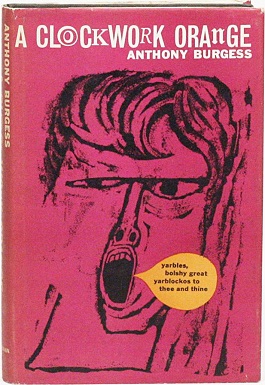
A Clockwork Orange


If you can manage sitting through the awful narration, that is to say Nadsat and all the horrors it brings on sentence structure and half-translations of sentences, then it’s a good book. I compare it to watching a movie in which the camera work is total shit and shakey, like Cloverfield or Quantum of Solace or something really nauseating (I think of this analogy because I recently viewed The Hunger Games and nearly vomited during the entire 2 hours of shit cinematography). Once you are past all that, it is really a good book, very moving and insightful.

Children are assholes, we all know this because we were all children once. But the kids in this book are fierce, terrifying and absolutely out of control. As if I was not put off enough when he destroys a man’s books in the early going, they also assault him and leave him bleeding and crawling, only to move on in the evening and commit a very horrible rape crime that is worked out in details that are not too vivid, and so less violent and disturbing at face value, but almost more horrible because the narrator and perpetrator, Alex, skims along the act and leaves a lot out and it sort of gives you the idea he isn’t all that bothered by it. As though he needs not focus too much on the act because it just is not that big a deal to him. Really terrible.

He moves on to committing a few too many senseless crimes and is later imprisoned for them. Rightfully so. Good, we can all inhale deeply and take solace in the fact that the justice system is doing its work and bad people are punished, learn their lesson and life is good, right?

Alex begins to lose his identity in prison, beginning with losing his name and being referred to only as 655321 during his stay. Sometimes criminals get out on good behavior, but Alex chooses to get out early via the Ludovico Technique, a controversial brain-conditioning program that will reset his behaviours to fearing, terribly, any act of violence or cruelty. His chaplain, whom he is closest too, warns him of the dangers of losing his free will and all ability to choose the proper path, but he ignores it. And just before his procedure, he commits one final act of superior violence by killing the new inmate that is stirring up trouble with the four of them living in their cell.

Alex is released to find himself in a struggle. His family has moved on and so have his old droogs. Though he would like to move on as well, he is still recognized as a menace and not given the chance he was promised to fit into society. One of his old droogs and a former rival are now members of the police and use their power to intimidate, beat and ultimately, rape him. He’s rescued by the man he once met and knows only by two facts: (1) that he is the man who writing A Clockwork Orange when Alex broke into his house and (2) he is the man whose wife Alex and the gang raped. He learns that she committed suicide sometime after that and Alex finds himself as a martyr for a cause that is trying to bring down the oppressive government regime that is responsible for this society being in its current state.

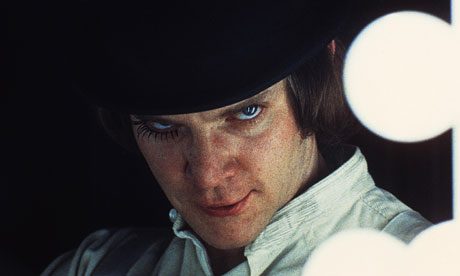
The pressures of it all plus some bad side effects to Alex’s conditioning, brain washing really, force him to attempt suicide and the near-death experience resets his brain and undoes all the washing. So the violent sociopath is back and really gets his way again. In the final chapter – omitted from the early US publication and therefore omitted from the Stanley Kubrick’s film – Alex realizes that he will eventually have a baby and it will grow up to be as big a piece of shit as him, and he will be as powerless to stop it as his parents were to stop him, and so on for generations. I have heard why it was omitted, that many readers would falsely interpret a happy ending, but it really does belong in there. It gives you a sense of how difficult it is to change the culture of a violent group in any society.

So the original British version had a much better ending for me, but the entire book leaves you with a kick in the chest as to how shitty crime evolves amongst misled youth, gangs, gets treated in the prison system and in the end, reproduces. Very desperate feeling to it after it is all over and I dig that.

Lastly, for a little story on how the book was written, check these strange facts out that I found on Tor.com (a favourite website for sci-fi/fantasy nerds everywhere).


Sunday, April 8, 2012

Doctor Zhivago


Well I thought I’d go Russian, again, for a chance to get my feet settled back on familiar hard ground. Hard, unapologising, unrelenting and completely unforgiving ground. Doctor Zhivago is a tale of…love? No that’s not quite right. War? Famine? Revolution? Journeys through the dark, lonely unknown to discover that ultimately nothing in life can bring you happiness? It is all of those things, but even more.

One of the most incredible books I have ever read, and I don’t always say that even about books I like. I have never come across a character so conflicted, from so many different facets of a life full of despair and unfair disadvantages. Even second chances are cruel to the antagonist.

I have read of characters that have perhaps more severe conflicts and sources of torture: Orson Scott Card’s Ender Wiggin, Frank Herbert’s Paul Atreides, Nabokov’s Edgar H. Humbert, Dumas’s Edmund Dantes, and so on. But no one has so many converging ideals and changes of belief, changes of heart from warring sides than Doctor Yury Zhivago.

Raised without a father – who committed suicide after losing his wealth and being misled by a conniving laywer – Yury rises through a dangerous Moscow to eventually become a member of the bourgeois class after attaining a medical degree. He sympathises with the working class’s ideals, however, being very much in touch with the heart of Moscow and realizing how unfair the current system can be.

But after traveling to the front lines of World War I, his ideals begin to shift. He no longer thinks violence should be used to convey a message, and that there are no ideals strong enough to warrant the taking of innocent lives.  And when he returns, he is appalled by the violence of the October Revolution and flees with his family and father-in-law to a small town in the Urals. Did I mention the Mother-in-law didn’t make the trip because she dies a miserable death early on, tortured so much by her past with the yet-unconnected but exact same conniving lawyer who has influenced Yury’s life? Well despair overtakes her and she tries killing herself with lots of poisons, but Yury saves her life and gives her a few more dark, depressing years.

Now that the remaining happy family has survived World War I, the February and October revolutions, they make their way out of Moscow to live on their own in the Urals. Along the journey Yury meets and deals with desperate people on the run, similar to him, as well as soldiers fighting for causes some feel passionately enough to kill for and others aren’t so sure, and become deserters even at the threat of the death penalty for these actions. Once in the Urals Yury rekindles an old flame with Lara Fyodorovna, wife of a Pavel Antipov and neighbor/acquaintance of Yury’s growing up Moscow as well as a nurse he came to know and admire and, secretly, love during their time together in hospitals near the frontline in WWI. Lara had tried to pursue her run-away husband who left her because he felt he didn’t deserve her and sought to gain renown as an infantryman, fighting gallantly to defend, and in the near future help reform Russia.

The plot thickens as Yury develops an affair with Lara, and before he comes to terms with admitting to his wife Tonya what has been going on, he’s captured by the “Forest Brotherhood,” a guerilla fighting force led by a cocaine-addict that is actually a separate entity from the Red Army, but still fighting viciously against the Whites. Forced to treat people fighting for a cause he doesn’t support, Yury begins to lose taste for his profession, especially after being pinned down by White Army cadets (which is a nice way of saying teenagers with guns fighting for the cause he does support) and forced to take action and shoot at them in order to escape. He begins to contemplate leaving the Forest Brotherhood, which is risking his own life, because of the conflicts he feels being a medic for a Red-sympathising guerilla force.

But of course, these mixed emotions about the ongoing conflict just aren’t complicated enough. So the Whites throw in an extra element when they torture a man by removing one arm and one leg and force him to crawl through the forest back to the Brotherhood’s camp. There he tells them of the unimaginable horrors in store for them all as the Whites begin to close in on their region.

Strelnikov, a displaced Pavel Antipov who is now a former POW with a new name and blood lust for White Army soldiers, ends up breaking through and the Reds move on to victory after Yury escapes from the Brotherhood. He’s no safer in public now, however, and must keep a low profile, abandoning a force fighting against the Whites in time of war is reason to face the firing squads in this time, and after he learns that the Soviet government now looks unfavourably upon the Forest Brotherhood, likely for being too independent, he has no one he can trust. Even Strelnikov falls out of favour with the Soviets (as his mysterious and charismatic nature gained him loyal followers, he also gained the attention of the Communist Party as a potential threat moving forward) and is on the move, all alone, much like Yury.

The two of them meet, whilst both in hiding, and after Yury tells Strelnikov that Lara is as inaccessible to him as his estranged wife Tonya (now living in exile in Paris with their kids and her father), Strelnikov shoots himself. Of course he does. Yury winds up making an attempt to salvage his life as a poet and translator in Moscow, living the slums, taking a wife, having children and then leaving her too and eventually suffering a heart attack on the streets. Lara makes it to his funeral and is later arrested and put into a Gulag, a sort of concentration camp in Siberia Stalin was very fond of using.

The story ends with Zhivago’s friends, Dudorov and Gordon, talking about how they survived the Gulag’s to become WWII servicemen, as well as talk of a young girl named Tonya who very much resembles Yury and Lara and the physical/personality traits by which these two came to associate them.

Needless to say, Boris Pasternak was in deep shit with the Soviet Union, Stalin, the KGB and Writer’s Soviet when the book leaked out of the USSR and was printed in several other languages before the USSR ever authorized its publication in Pasternak’s homeland. He was also “encouraged” by the KGB to decline the Nobel Prize for Literature he won that year.

I think people of my parent’s generation are much more familiar with this story, as the movie was a huge hit when it came out and everyone at the time was a big Omar Sharif fan. But for my generation, I think this book goes largely unnoticed. And I can’t see why. There are probably too many lists out there of the top 100 novels, or top 100 modern novels, or any essential book collection, and Doctor Zhivago doesn’t seem to be prevalent enough on those lists. There is no reason it should ever be placed outside of the top 25 on most of these lists. But, we do live in America, and most people can’t handle this much conflict.