Popular Posts

Showing posts with label Mystery. Show all posts

Thursday, August 15, 2013

Make Room! Make Room! - Harry Harvey Harrold-Harrison

“SOYLENT GREEN IS PEOP – “ wait no, that was just the movie. A movie which is, admittedly, loosely based on the book. So there are no dead bodies floating their way through a factory coming out as green crackers of protein. Though I must confess, I was constantly examining the pages left until the end as I approached the climax of the book thinking “when is he going to follow his dead friend to the Soylent factory?” 

Though Charlton Heston is once again wonderful, perhaps more so when written as a character, this book is very different from the movie.  And different in a way that can still truly be appreciated. It is a detective novel in a dystopian, poverty-ridden, overpopulated, hungry world. A much less technologically advanced and shittier-outlook-on-life futuristic detective novel than, say, The Blade Runner. The universe is constructed well, much better than the sort of abstract android-assisted future in Blade Runner and certainly a much more believable future than the universe in Suzanne Collins’ The Hungry Games series. Both of those dystopias are very different, I get it, but the United States and, specifically, New York City in Make Room! Make Room! is so well constructed, probably because it focuses on a much more near-term crisis, only a couple generations out from when it written.

Another element I enjoyed is how it is set essentially in one small area, in Manhattan, in a single precinct of Manhattan virtually the entire book. The weight of the problems shared by the famished of the entire world seem to bear down harshly on the citizens of New York, and as overpopulation, hunger, and violent crime are main elements, NYC makes the perfect setting and there really is no need to stray from it; the city is expanse and populated enough to house a complete murder mystery novel in one individual precinct.

The relationship between Sol and detective Andy Rusch is also interesting, as is pretty much each relationship Rusch has. The dynamic of the two is so polarizing that it is almost comical, and because there are similar relationships with friends and family of mine, I did find it rather entertaining. Sol seems to have a wise man’s approach to the world’s problems: is a very level headed, rational thinker and backs up his philosophies with sound reasoning or, at worst, relevant experiences. He is willing to sacrifice himself and his goals to see that the world becomes a better place. Yet he does nothing to change the direction his path is taking or make his voice heard, until it is too late.

Andy, by comparison as well as contrast, will put up with nearly any injustice as long as he has a place to call home and a job that can help support a recurring source of food and water. He is very career-oriented, puts his job and his income above his personal happiness, will sacrifice his relationships to follow orders, and even when shit hits the fan and all signs point to him needing a change of scenery, he cannot let go of that steady job in such a great depression.

His relationship with Shirl is even more dynamic. Those two have issues, people in poverty and trying to be happy whilst still making sacrifices type issues. And when the man works so doggedly, so exhaustingly, and the woman has nothing to do but lament her past life as a playgirl, she tends to seek escape and sleep with other people. Happens in mining towns all the time. This instance was really very believable to me. 

The end of the book features very nasty breaks of Andy’s relationships, pretty much every link to him in the story either fades, escapes, or dies. He is all alone, but cannot let go of his fear of losing what he has to stand up for himself. And if we do not recognise that is what drives people to sacrifice their personal freedoms and liberties for the sake of economic or social security, then we have learned nothing.

Good book.

Lastly, as I was finishing this book, THIS was being hotly debated in my office. Not just its existence, the background of the nature of the research, the funding, but the implications and corporate supply/demand/marketing capitalistic flaws inherent with new technologies. I was excited for it, but humanity's, specifically capitalism's, track record with stuff like this is very poor (*cough* MONSANTO *cough cough*). 

Monday, July 8, 2013

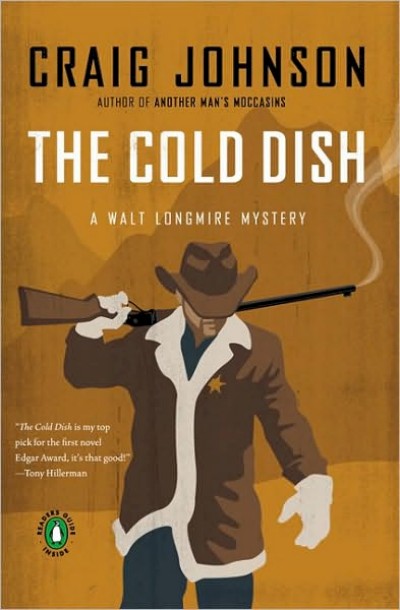
The Cold Dish - Craig Johnson

Gazpacho is a dish best served cold. That is mostly what this book is about. Cold dish stuff. Like revenge. And vengeance. And avenging someone. Any and all venge related words happen here, and the Sheriff is trying to play detective to prevent the vengeant from avenging, revenging, and vengancing the vengee. The characters are pretty good in this story. The main character is a bit down, feeling sorry for himself, and lives in a self-loathed squalor. But he truly is a great sheriff, very representative of small town law enforcement. Even drinks on his way home in his cruiser.

After his wife died, he did not necessarily go into a deep dark depression, but instead just melted into a sloppy, unmotivated, unambitious version of himself. Then the murder happens. Talk about a hell of a shot, ballistics and detective work eventually find out the round was from a Sharps .45-70. One of the best rifles ever made. Not so much a rifle, really, but a shoulder cannon. Or better yet, an explosion that just hurls a baseball weight of lead at its target hard enough to put a bison down at 300 yards. Hence the name, Buffalo Rifle. It is also capable of taking down a person at a better range, though that takes a great shot and even a bit of luck, as the bullets do not fly very true beyond 500 yards, which tends to be its practical range for shooting targets in the field.

In any event, the author knows much about this gun and other guns in general, and as the sheriff learns about them, everyone gets walked through the history and the mechanics of these  breech loading canons. Truly awesome weapons, but very difficult to shoot. Pretty funny, also, that there are so many in such a small town. Irony that is not lost upon the sheriff, which I appreciate. Kind of like a moment when the character in the story says “this story is sort of weird, but okay.” I think this happened on multiple occasions, but my memory is a bit foggy on the other instance. It was something to the effect of him answering another member of the community with “I’m not sure it’s a murder mystery yet, but if it is, there aren’t many butlers in these parts.” Not sure the details of the joke, but I make butler jokes all the time in murder stories so I thought it was great.

Again, the characters were all great, Henry Standing Bear probably the best of them all. Omar in perhaps a close second, but virtually all characters, very minor or major, had their own identity, contributed something to the storyline, and created that bit of small-town community whilst still being true to the small-town drama queens that I am more than just a little familiar with.

The pace was great, the mystery was pretty good, and the ending was getting to be a bit frustrating but ended up being okay. Violent, and violent to the point of the author taking the approach “we don’t need to talk about how gross that is, but trust me, it is devastatingly disgusting.” A .45-70 is capable of incredible damage, and I felt the damage it did to the murder victims wasn’t sensationalized or over-exaggerated. But in the end? Best we all don’t know how that one ended up looking.

This was enough to throw the sheriff into a strange depression. It lasts for several weeks, and by the time the book is over we don’t know if it will last longer, be something he carries with him forever or just gets over and gets back to being the sheriff. Guess we’ll have to read the next one to find out.

The combination of old school style, vaguely sexist and only slightly above the law, makes me think of the noir mystery novels I really like. But set in a contemporary western environment I can relate to much more. Pretty good combination, though I still will deny it being a great book, I will say it is a good one. Maybe because a mystery series just isn’t really my thing.

Tuesday, December 25, 2012

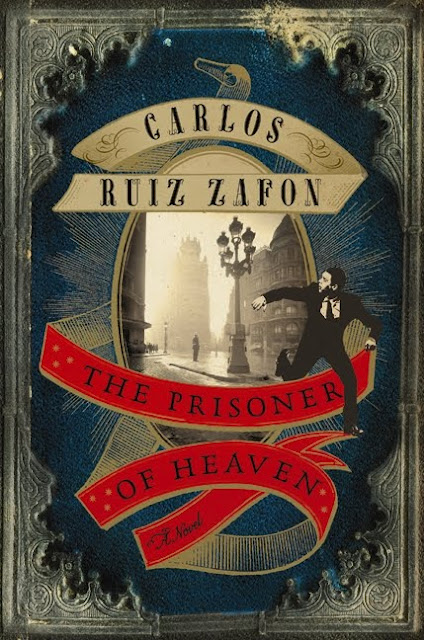
Prisoner of Heaven


Or Shadow of the Wind Part 3, or Cemetery of Forgotten Books vol III, or Angel’s Game Part 2. Whatever it is called, it is Carlos Ruiz Zafon’s third book in a gothic series relating Barcelona post-Spanish-Civil-War to a family struggling to maintain a bookstore, a real awesome cemetery of forgotten books (which is like a library of Holy Grail conditioned books banished from contemporary society for any number of reasons), and the Sempere family. Though the series started out with one of the best books of the last ten years, and I am not exaggerating to reinforce my point on the other two, the books that followed just didn’t seem to contain the same awesome crime-mystery-thick plotlines with great points on the wickedness of people keeping secrets, the twisted nature of war and its longterm affects, and the general magic with which Zafon writes. It was almost as if the second two were written by another person trying to cash in on the fame of the writer of the first one.

Anyway, this book deals a lot with the same family we were introduced to in the first book, only at a much later time. Daniel is all grown up now and is a father. Fermin is looking to get married to Bernarda and the bookstore is, predictably, struggling. Fermin’s wedding prompts the issue we were introduced to in the first book but didn’t worry too much about, his fake name. His lack of real identity. His true identity cannot be known because he changed it during the civil war and for all intents and purposes became this Fermin Romero de Torres.


 So he tells Daniel why he did it, and that story becomes the plot, or most of it, for this book. It covers his time in prison during the conflict (or shortly after the war, I am not really familiar with the history of Spain), and his time in a cell across from the guy who is the main character of the second book. Not only does this plot totally try to mindfuck what the reader thought was going on in the second book (if you haven’t read it yet, The Angel’s Game, don’t bother, as The Prisoner of Heaven suggests none of it happened that way anyway), but it also weaves its way into about a 100pg section recreating the prison scene of The Count of Monte Cristo.

Don’t get me wrong, I completely agree with Mr. Ruiz Zafon, The Count of Monte Cristo is one of if not thee greatest book written in modern literature. But you can’t just take a scene from it (which, since it’s a 1,000 pg book, each scene is a novel or novella in itself) and use it as the plot for a modern day book. It just doesn’t work. It also doesn’t if you’re trying to tie into another book in your series but without really tying into it, just saying “that whole time you that this was happening…well that was happening.”

Aside from all my whining, it is a good book, just with a weak plot. Its greatest flaws are that Carlos Ruiz Zafon wrote an absolutely mind-blowingly good novel in Book I of this series, The Shadow of the Wind, and each book since has disappointed fans of him and the series; and other flaws include the aforementioned Alexandre Dumas tribute gone wrong and a plot that just doesn’t amount to much. I meant the villains in the story meet unexpected ends but not in a way you’d dramatically, climactically hope for, especially after reading The Shadow of the Wind.

And apparently, Carlos is Espain's answer to Karl Pilkington
My ultimate review comes down to this: Read  the series thus far in reverse. And let me know, when you get to The Shadow of the Wind, if you liked it as much as me. Seems you will, as each book will build to that magic moment in literary history (it was good beyond description…every sentence was so well thought out and placed and written I couldn’t do it justice with a review here, honest!), until you reach the punch line or “ah-ha!” moment of it all. Just, someone, for the sake of literature and recommendations, please try it. So I can know if that’s how I should recommend these books to friends. Because I have unfortunately made a friend read The Shadow of the Wind not long after I read it and he still has not picked up a copy of the others. I could be ousted as a good source of recommendations if I tell him to continue the series…