Popular Posts

Showing posts with label Indians. Show all posts

Monday, July 8, 2013

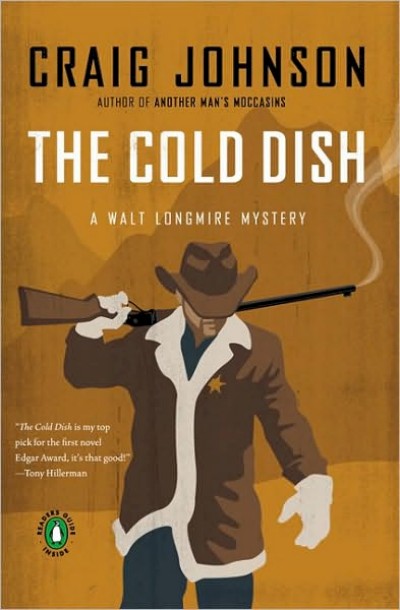
The Cold Dish - Craig Johnson

Gazpacho is a dish best served cold. That is mostly what this book is about. Cold dish stuff. Like revenge. And vengeance. And avenging someone. Any and all venge related words happen here, and the Sheriff is trying to play detective to prevent the vengeant from avenging, revenging, and vengancing the vengee. The characters are pretty good in this story. The main character is a bit down, feeling sorry for himself, and lives in a self-loathed squalor. But he truly is a great sheriff, very representative of small town law enforcement. Even drinks on his way home in his cruiser.

After his wife died, he did not necessarily go into a deep dark depression, but instead just melted into a sloppy, unmotivated, unambitious version of himself. Then the murder happens. Talk about a hell of a shot, ballistics and detective work eventually find out the round was from a Sharps .45-70. One of the best rifles ever made. Not so much a rifle, really, but a shoulder cannon. Or better yet, an explosion that just hurls a baseball weight of lead at its target hard enough to put a bison down at 300 yards. Hence the name, Buffalo Rifle. It is also capable of taking down a person at a better range, though that takes a great shot and even a bit of luck, as the bullets do not fly very true beyond 500 yards, which tends to be its practical range for shooting targets in the field.

In any event, the author knows much about this gun and other guns in general, and as the sheriff learns about them, everyone gets walked through the history and the mechanics of these  breech loading canons. Truly awesome weapons, but very difficult to shoot. Pretty funny, also, that there are so many in such a small town. Irony that is not lost upon the sheriff, which I appreciate. Kind of like a moment when the character in the story says “this story is sort of weird, but okay.” I think this happened on multiple occasions, but my memory is a bit foggy on the other instance. It was something to the effect of him answering another member of the community with “I’m not sure it’s a murder mystery yet, but if it is, there aren’t many butlers in these parts.” Not sure the details of the joke, but I make butler jokes all the time in murder stories so I thought it was great.
Again, the characters were all great, Henry Standing Bear probably the best of them all. Omar in perhaps a close second, but virtually all characters, very minor or major, had their own identity, contributed something to the storyline, and created that bit of small-town community whilst still being true to the small-town drama queens that I am more than just a little familiar with.

The pace was great, the mystery was pretty good, and the ending was getting to be a bit frustrating but ended up being okay. Violent, and violent to the point of the author taking the approach “we don’t need to talk about how gross that is, but trust me, it is devastatingly disgusting.” A .45-70 is capable of incredible damage, and I felt the damage it did to the murder victims wasn’t sensationalized or over-exaggerated. But in the end? Best we all don’t know how that one ended up looking.

This was enough to throw the sheriff into a strange depression. It lasts for several weeks, and by the time the book is over we don’t know if it will last longer, be something he carries with him forever or just gets over and gets back to being the sheriff. Guess we’ll have to read the next one to find out.

The combination of old school style, vaguely sexist and only slightly above the law, makes me think of the noir mystery novels I really like. But set in a contemporary western environment I can relate to much more. Pretty good combination, though I still will deny it being a great book, I will say it is a good one. Maybe because a mystery series just isn’t really my thing.

Sunday, March 17, 2013

Prentice Alvin - Alvin Maker: Book Three

Jesus fucking Christ guy, are you Mormon or not! Orson Scott Card, after talking about how much he loves and respects the red man (Injins for those of you more PC) at the beginning, and then throughout, Red Prophet, comes back with a hard punch to the chin regarding slaves and rape, and slaverape, and rape-slaves. And I was familiar with how he speaks down to Native Americans when he is using the point of view of a hateful, villainous, no good settler or white politician like William Henry Harrison (called “White Murderer Harrison” by the reds) or “Old Hickory” Andrew Jackson. But holy smokes, nothing can prepare you for the hatred toward blacks by slave owner Cavil Planter and his new buddy, Reverend Philadelphia Thrower (he was the preacher that was in league with what I thought was the devil in Book One).

I do not mean to scare off children thinking that this is a kids’ book or a kids’ series, because they should know damned well by now it is not. Young adult, yeah maybe, in the same sense His Dark Materials is young adult. But people actually let children read this stuff! It just blows my mind.

Oh man, anyway, plot revolves around Cavil Planter seeing a vision of an angel that is eerily similar to the one Reverend Thrower saw in book one, the one that instructed him to kill Alvin. This angel says that the white man can conquer and civilize the blacks, but it will take a long time. Whipping them into shape, literally, is one way. But another is not to allow them to reproduce within the slave quarters, and instead slowly start to purify the bloodlines but producing whiter and whiter babies. That is where slave-rape comes in. And after his first, she runs away, uses her black magic she learnt from her time in Africa (her father was a witch-doctor) to turn into a raven and fly away with the newborn babe.

She dies and the babe is to be raised by the folks at Hatrack River, the same ones that helped Alvin come into this world. She is found by Peggy’s father, who is running an underground railroad of sorts and helping runaways escape the slave laws of the southern and Crown colonies, and helping them get to Canada! But this baby will never make it. It all goes down as Alvin is on his way to become a prentice, a year late and fully recovered from his capture by Tenskwa-Tawa.

This forces Peggy the Torch to flee the area, not wishing to let Alvin ruin her life or allow herself to ruin his. So he enters his apprenticeship, and works through much of it, without knowing how much she does for him. He befriends her family as well as young Arthur Stewart, who is named after the King of England as a joke to diss the King of England…I think. Not real sure.

Anyway, his master, Makepeace Smith, is a real asshole. And slave owners who are down 2 slaves with the runaway who took her baby with her go after Arthur, fueled by a chance meeting between the two most disgusting people in the series thus far: Reverend Philadelphia Thrower and Cavil “Slave Rapin” Planter. Rev. Thrower knows Alvin all too well, and has updates from friends of his family that he is in the limelight for befriending the “mix up boy,” as everyone refers to Arthur. This is all Cavil needs to send Slave Finders out.
Finders have the knack of being able to identify people based on a bit of hair, or skin, or blood you give them and let them carry around. They’re like fucking bloodhounds or something. And obviously, because this is America, they use their knack for money in the sickest way possible.

Peggy comes back, eventually, in a disguise that helps her be known to everyone only as Mrs. Larner, a middle-aged school teacher for hire. She teaches in Hatrack River and then takes on Arthur, more in the role of tutor as he is disallowed form school, but also teaches Alvin. Obviously, he falls in love with her and Finders come about and shit gets real, and death that will surely start more trouble ensues. The book ends with Alvin leaving Makepeace to become a Journeyman, he and Makepeace are real enemies by this point, and Alvin sets out on his own for the first time. But not before more rape involving slaves, only this time it is slaves raping white women. What a way to cap off a pretty intense book for this series. Definitely caught me off guard.

Cheers! Can’t wait for Book Four!

Thursday, January 31, 2013

Red Prophet - Alvin Maker: Book Two


Continuing from Seventh Son, Orson Scott Card picks up the story with an entirely new plotline, which sees a whiskey runner coming to visit William Henry Harrison in Fort Dekane. This runner's knack is that he is a spark, in that he can focus his energy somewhere to create a heat source. Of course it's difficult to burn a forest this way, but something highly flammable/explosive is easy for him to ignite. And since this is a bit more of a sinister knack, it's best he keeps knowledge of it to himself and use it as a defense. All sorts of double crossing is going on, and we are introduced to Tenskwa-Tawa and Tecumsaw, a couple of badass natives from the Shawnee tribe that are influential throughout this book and I’m guessing throughout the rest of this series. It ends up that Tenskwa-Tawa meets Alvin and we get a replay of the vision he shows him when he appeared in Alvin’s room to teach him about his powers. He is only able to do this as he quits drinking whiskey, and from there on goes to lead a movement that teach all of the reds to refrain from consuming alcohol, much to the dealer AND Bill Harrison’s dismay.

But we also meet another figure in the beginning, when we are being introduced to the natives and Mr. Harrison, a rude southern man from Tennessee nicknamed Old Hickory. For those of you not up on your southern American history, that’s Andrew Jackson. Nobody hates the reds quite like him, both historically and in Card’s second Alvin Maker book. Except of course, maybe Bill Harrison. Who is a real SOB.

In fact, Harrison and Jackson have such a hatred for the reds that it scared Tenskwa-Tawa straight. He is a noted drunk and constant dependent on the whisky which he uses to drown out the horrors of watching Harrison murder his father when he was just a boy. Well thanks to his brother Tecumsaw he sees the light and weens himself off of it, becoming a wise man, or shaman, or whatever.

There are other chapters up front that bring in the French, who are operating out of Ft. Detroit (DETROIT Represent!) and are paying money to the reds for scalps of white Americans to help manufacture some majour conflict between American settlers and native Americans. In this French campaign, being led by General de Lafayette, we meet a young Napoleon Bonaparte, whose knack is the ability to get anyone to fall head over heels in love with him. Too bad Lafayette has a charm that acts as a shield from his knack. Lafayette also despises the French King, Louis XVI (at least I think that’s the number) and would rather the loyal, fiery yet ambitious Napoleon break away from servitude to the French King and begin a new world and a new order. So there's another agenda.

There is enough American folk magic and historical fiction to be really great in this book, even if the premise is a bit weak in places. William Blake, better known as Tailswapper in this series, is still a phenomenal character, even if the guy doing his voice in the audiobook is really annoying. He still understands enough about visions from his always wanting to have one, to recognise Alvin's. He also takes part in an adventure/vision that requires him and Tecumsaw as they battle fate and their own understanding of what humanity requires with their own stubbornness. They must unite to escape with their lives, but they can’t stand each others' ideals and are even more appalled at the glimpse of each other’s destiny.

I guess it is an adventure story of sorts from the moment Measure and Alvin are kidnapped in the woods until the very end, and that makes it quite a bit different from what I was expecting after finishing Book One. But not necessarily in a bad way, I was just hoping for mystery and freaky unexplained characters and their conspiracies than an adventure story solved with a series of visions. But since things are somewhat reset after a brutal massacre of thousands of Indians and some failed wars, I bet Book Three gets to be more to my style. Looking forward to that one.

Sunday, October 14, 2012

Blood Meridian

Or as I like to call it: The Western section of my library’s tribute to the holocaust. Good God. Okay, where to begin. The book isn’t good. But I read it because it was on the book club list and I did not want to be that guy who read one book by an author (Cormac McCarthy’s The Road) and say I’ll never open up to anything of his again…especially with how much acclaim this guy gets.

Well, I read it, open mind and all, and even liked bits of it at times, but in the end, it was just too much McCarthy. That is to say, there is no point to anything and the violence is so rampant and unrestrained one sort of gets desensitised – no that’s not right, that’s what you say about actual violence – acclimated to it.

The book begins well, a boy in a broken home whose mother died at birth and violent father could never accept him runs away, and quickly the action picks up when he enters a preacher’s tent for a sermon. The preacher has a weird way of talking, combining King James’ New Testament Gospel with that ignorant redneck western country talk, and is interrupted by a man we come to know only as the Judge. The Judge tells the crowd this preacher is a fraud, speaks the way he does because he is illiterate, and may seem new here, but is on the run because of committing several different forms of child-rape and molestation crimes in various parts of the United States. The crowd is in uproar, charges the preacher and eventually kills him. 

When we meet the Judge again in a bar, the boy (and the main character is only known as the boy in this book, except when he’s known as the man, very McCarthy-like) asks the Judge how he came to know this preacher, to which the Judge says “I’ve never heard of this preacher before today. Just wanted him out of here.” Or something like that.

Awesome start, right? Well the awesome was basically over right there. The Judge is a very interesting character and all, but he helps lead a band of Cavalrymen on an Apache hunt gone wrong and every chapter ends up following the same basic order: travel, massacre, rape, massacre, rape, murder, molestation, other violent crime, massacre, capture, escape, repeat.


About the only thing of interest is its historical significance, which is mostly in regards to John Joel Glanton. Apparently the Glanton is one of the most notorious scalp hunters of the American West. That’s great. Really terrific. It just doesn’t make for an interesting fictional book to read of his adventures skinning Native Americans, impaling enough dead babies on a tree to create a sort of “dead babies don’t grow on trees” irony, picking fights in bars and killing everyone inside, things like that. I just felt nothing reading this other than “I can’t wait for it to be over and me to never have to read another Cormac McCarthy book again.” 

And I’m sorry if you liked The Road. It was really terrible. But if it is your style, you may just like Blood Meridian

Sunday, September 30, 2012

Seventh Son – Alvin Maker: Book One


Alternate History: it is a subgenre of fiction that I am getting in to more and more as I evolve my taste of Sci-fi/fantasy. JonathanStrange & Mr. Norrell had some of it, but what better way to really dive into it than from a book written by one of the modern masters of Science Fiction? And I feel like I need to include that this alternate history is primarily American History. How much fun would it have been to have Thomas Jefferson as a revered witch, Benjamin Franklin as a magician, George Washington as a martyr? I cannot think of a more masterful take on American alternate history with folklore tied into it.

The tale of Alvin Maker begins like any good, kickass Orson Scott Card sci-fi story: a child with a unique talent that he/she does not quite understand and is punished unmercifully for it. In this case, it is the torch, young Peggy Guester. She is the first person we are introduced to and though she plays a majour part in the protagonist’s role, she is mentioned very little.

The untimely death of the eldest son happens just as Alvin is making his impromptu appearance into this world, being born only with the help of the little girl whose knack is that of torch. She foresees his powers, and is able to realize that he is the seventh son of a seventh son.

The Seventh Son is also my introduction to this particular bit of folklore; that magical superstitious sensation of seventh son and better yet, seventh son of a seventh son. Turns out Orson Scott Card did a bit of research on that.

As a devout Mormon, he also has a majour Christian influence in this story. But because it is during that pre-Mormon-anti-gay-Extremist part of his life, it is actually not the sort of Christian influence you might expect. Preachers in league with the devil, atheist protagonists, highly religious figures who unknowingly succumb and submit to the powers of knacks, hex and spells, and perhaps best of all, this quote from Armour-of-God Weaver when discussing an equally awesome character:
                
“They say he knew that wizard Ben Franklin. And that atheist from Apalachee Tom Jefferson.”

Two of my favourite historical figures. And made all the more badass in this alternate history. Not all Christians in this book are crazy, but for the most part, there is a clear, often hostile line drawn between the Christians and the practice that the others have for an active, powerful working spirit world.

Oh and the other great part about the above mentioned quote by Armor-of-God, the man he is talking about is a lonesome, vagrant story teller who walks around the American frontier with two goals: 1 – to have a vision (which never happens, no matter how hard he tries); 2 – to exchange honest labour for food/shelter and the ability to swap stories. His name is Taleswapper, and though he is a great character, really the best in the book, he lets it slip that his real name is William Blake. What a fantastic (fictional) historical twist!

Alvin experiences pain through his own evil doings, cheats death and learns to defeat it, but what everyone suspects is that he has to actually use special powers to cheat death. Meaning that he both possesses special powers and is being hunted, rather creatively, by some evil force. We learn to call this force The Unmaker, thanks to Bill Blake’s eloquence. The Unmaker and some devilish being have it out for him, and ironically, so do the hardcore Christians of early America. Through his power, the will and spiritual/philosophical goodness of the natives (called reds in this story), and Taleswapper’s cleverness, he is able to learn some balance between his unique gift and the evil that is both hunting him, and working its way inside of him. For a relatively short novel, it is magnificent with typical Orson Scott Card torture towards an unknowingly powerful child. 

Whether or not Book Two and all the others slow down, Seventh Son is absolutely fantastic and a refreshing jolt of creative fantasy that doesn’t just rely on children’s love of monsters and spells (no offense Harry Potter fans) nor does it require goblins, trolls or elves to be truly engaging (again, no offense to my Lord of the Rings readers).