Popular Posts

Showing posts with label Fantasy. Show all posts

Monday, September 16, 2013

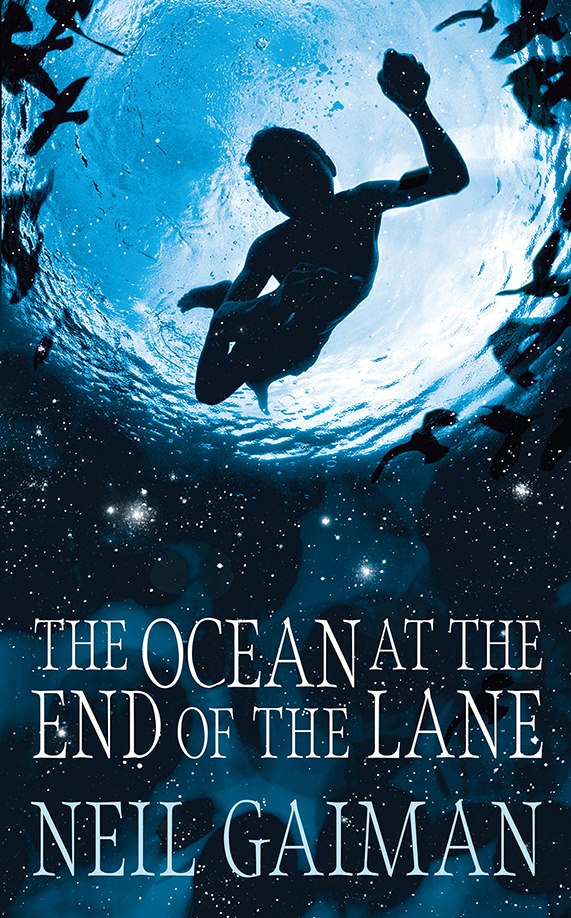
Ocean at the End of the Lane

So Neil Gaiman went and wrote another story for children! Then another one, about a child, that I sort of had the impression might be a children’s book in the same light as His Dark Materials are children’s books.


It is about a man who is attending a funeral and makes a stop at the house on the end of the lane where he grew up, remembering his friend Lettie who had an ocean in her small pond. He then flashes back, and the story takes away to the time when he was seven, remembered by referencing his seventh birthday party – a party in which nobody showed up and he took his books and his Batman figurine upstairs to his room. He then learned that he was to be moved from his room to make way for a new tenant, as money was tight, and a South African opal miner shows up, runs over his cat, gives him a stray to make up for it, then steals his father’s Mini and kills himself in it. This event brings about a creature from another dimension, and she throws money at people and tries to hurt them whilst giving them things they desire. Lettie and the young man venture into the other realm to make sure the creature no longer throws money at people, and it uses the young boy as a door to cross into our realm. The monster shows up as an attractive young nanny to take care of the boy and his older sister, very much in a creepy Merry Poppins sort of way, if Merry Poppins were a babe, and named Ursula Monkton. Ursula puts everyone else into some sort of trance, becomes vindictive and nasty towards the boy, then gets his non-violent father to try and kill him by drowning him in the tub, then has sex in the study with the boy’s father as he escapes, then gets eaten by ravenous shadow-figures that are sort of like birds.


Pretty cool children’s book, if you ask me. I would let my kids read it. But not before they finished His Dark Materials.

I liked it, not just for all the reasons I mentioned, but because the story telling was so good. Gaiman really never ceases to surprise me with his quickness in taking a story from one direction and turning it on its head. This one had a lot of elements from others, namely Neverwhere, Graveyard Book, and Stardust, for me. Neverwhere, in the sense that a person visible and knowable in our world can become a door to the other world, which is not just a clichĂ© fantasy but some sort of fucked up imagination I probably would not voluntarily visit that exists in Gaiman’s mind. And Graveyard Book because of the way the Hemstock family are all liminal figures who understand and can determine who and what goes in and out of each realm and orchestrate maneuvers that keep everything in their proper place within the two. But, because they are liminal figures (which many of my favourite characters throughout literature often are), they share nothing about how they are able to do these things.


Also similar to Stardust is that misdirection, where Gaiman builds an air of children’s fantasy story-telling, letting you think that you may be reading a bit of a kids’ book, then presents fucking. And not “proper British sex,” either, but babes fucking dudes. It always gets me!
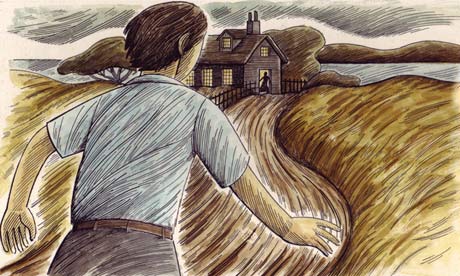
 Another, this time unfortunate, thing I realized when I read this book, is that Gaiman drew many of the background events to set up the plot from his own life. Which tend to be pretty fucked up. I say this is unfortunate, because the story-telling is so good that I finally came to the realization that all great authors pour into their works some elements of their own background, and the darker their past, the better the book. So events such as him climbing his drain pipe growing up, having a tenant who killed his kitten, stole his dad’s Mini and killed himself in it, being the only one present at his seventh birthday party, and still being excited to go read books and play with Batman toys, these things all make for a dark past and a great story. I was pretty regular, and pretty damned spoiled as well. I am therefore incapable of entertaining you all with something so inspiring.


Wednesday, March 27, 2013

Dandelion Wine – Ray Bradbury


First off, I’d just like to say that if you are reading this blog and you are not a Ray Bradbury fan, then kindly fuck right off and close this browsing window right this instant. He is one of the few authors I can apply the term “electrifying” to.  He dazzles. He makes me wonder at how great writing can be. And he makes me feel ashamed that I do not appreciate him enough. I own many books of his, several I have thoroughly enjoyed, some I am yet to read, and his short stories sit in a rather large volume on my shelf, unmolested, much to my dismay but entirely my own fault.

Many authors bring many different styles, and I have reviewed a large portion of my favourite authors on this blog: Neil Gaiman can write circles around the reader with a very “that’s exactly how I feel!” sense that comes to mind when he is read; Frank Herbert has a quality of delivering incredibly well thought out, unique plot-twisted and intense epics; Stephen King can wrap popular culture around a jagged, rusty blade of a storyline and stab it violently towards your eyes; Orson Scott Card will generally find the qualities of life you enjoy and use them as leverage to tear down a main character until he is the exact opposite of everything he is allegedly standing for; but Ray Bradbury remains un-trivialised on my blog. Let us change that, shall we?

He is, to me, what happens when incredible writing meets the everyday observation and is sprinkled in with a very modest, un-voluminous yet extremely powerful darkside. He does not dance around in his own cleverness the way Neil Gaiman does, yet they are very similar to me. He also does not bathe the heroes/heroines in despair quite the way Herbert or Orson Scott Card would, but I can see the relations and inspirations between them all.

Dandelion Wine represents to me a complete novel that fulfills all that I felt The Martian Chronicles lacked. Understand they are completely different books with nearly nothing in common. But both are novels compiled of essentially independent short stories tied to a central location/setting. I loved The Martian Chronicles, loved how it painted humans and our relationship with a new culture that is more of a state of consciousness than a simple second sentient race. But it lacked ringers. Stories that made you put the book down and take a few paces around the room, taking time out to appreciate the experience.


Dandelion Wine does not lack these moments. I do not feel I need to get specific, both for the sake of not spoiling anything for readers of the blog who have not yet read the book as well as for those of you who may have felt the way I did only with different chapters, but this book had individual stories of supreme brilliance.

Whether it was a simple description of the atmosphere one feels when in the prime of summer; the dread of seeing summer’s end; the thrill of scaring one’s self; the fear/acceptance of death and celebration/acknowledgement of life; everything seemed to be so clever and extremely relatable in the analogies and descriptions. In the end, I felt I lived through that Midwestern US summer of 1928 with Douglas and Tom in Illinois.

Whereas authors like Gaiman can be polarizing with their cuteness and subsequent filth in times of comic relief setting the stage for a quick, dark surprise, I felt like Bradbury simplified things in this book. Which serves well as much of the story revolves around two young boys, one a teenager and his brother a ten-year-old. Together they fantasize about the endless possibilities of new shoes. They philosophise and write down everything they learn and categorise human behavior as something “traditional” or “new”, something I found highly advanced for kids but was jealous of their cleverness; not because I could never think of that but because, in my experience, brothers tend to have a mutual let’s see what the riskiest thing we can do/dumbest lie we can tell/most dangerous behavior  complex. Not always, but two young males usually push each other in much the same way as Douglas and Tom, only in a direction that is less productive. So that was cool.

Wednesday, December 12, 2012

Pavane

Geez a month since I last blogged here, what the fuck has been up? Oh yeah, illness, work, travel and holidays. Sorry folks. Enjoy my review of this one though, I loved this book.

Keith Roberts wrote Pavane in 1968 as an alternate history if Queen Elizabeth was assassinated before England’s big battle with Spain and the Spanish Armada won; hence the Catholic Church ruled, Protestantism never began; hence technological developments and indeed all progression of human development was done only with the oversight of the Church. Need I say more?


It is a collection of short stories, or a novel told in small parts, all of which intertwine of course and have a few common denominators: the power of the Church, stunted technological growth (i.e. no electricity), the mechanical wooden semaphore towers and their Guild, feudal system, and the family of Eli Strange and his hauliers business of steam engine hauling cars.

I had no idea what a steam engine car looked like either. Makes sense though.


The Catholic Church being the sole source of knowledge, progress and science in a much less than preferred society was very reminiscent of one of my all-time favourite books: A Canticle for Leibowitz. It’s Dark Ages, monks abound and people fight and torment themselves in a helpless, hopeless, heart-wrenching quest for progress. Sad, but the empathy seems to come easy for characters fighting these fights.


The rebellion is also a thrilling factor. Or should I say, the Rebellion, as you seemingly cannot find anything about this book without someone quoting the first page’s brilliance:


"Over all, the long arm of the Popes reached out to punish and reward; the Church Militant remained supreme. But by the middle of the twentieth century widespread mutterings were making themselves heard. Rebellion was once more in the air . . ."


Brother John, who when I read this immediately thought of my new musical hero Father John Misty, is a monk tasked with witnessing and transcribing the acts of punishment to witches conducted by the contemporary equivalent of the Spanish Inquisition, referred to in this book simply as the Inquisition.  The torture scenes, for that is what they really are, become almost too much to bare, and are more violent and obscene than just about anything I have read lately, including 200 pages of Cormac McCarthy’s masturbation material, but is over and done with fairly quickly (maybe 3 pages) and helps shape Brother John into one of the most powerful, demented (yet not quite powerfully demented) heretics I have ever come to know in the world of books.


There is really nothing more fascinating to me than human beings behaving like non-human beings. It’s really a something I could study the rest of my life. Holy wars, for example. Totally awful behavior. But torturing people who speak out against your beliefs, or either just do not believe, quite innocently, or simply do not believe hard enough. That takes it to a whole new level. Incredibly awful stuff, and Roberts conveys it in a very meaningful way. Violent, yes, but not so much that you lose your lunch and have another 100 pages of baby impalement to get through after ten hours of stomach churning gore. Do I sound like I’m still bitter about Blood Meridian? Good.


The book also incorporates a feudal war. As a bit of a nerd for Medieval Epics and some of the stories of Middle English/Middle Germanic Kings and Queens – some of whom I still tell friends of whenever drunkenly possible – I really enjoyed the second to last story titled “Lords and Ladies.” It was the best for me, as the aristocratic governess, once again tying into the Strange family as she is the grand-niece of the main character of the first story, defies the orders of the Holy Roman Emperor and a war ensues with the Catholic Church as she tries to defend her people. The woman holding down the castle as the greatest army assembled on Earth has her entire land under siege was very much like one of my all-time favourite Germanic Medieval epics, Willehalm, and had perhaps an even more charming ending.

Really wish I had more to say without spoiling anything, but definitely pick up a copy of this book, or ebook it or audio it some way. Just....give it a go, it is great.

Sunday, September 30, 2012

Seventh Son – Alvin Maker: Book One


Alternate History: it is a subgenre of fiction that I am getting in to more and more as I evolve my taste of Sci-fi/fantasy. JonathanStrange & Mr. Norrell had some of it, but what better way to really dive into it than from a book written by one of the modern masters of Science Fiction? And I feel like I need to include that this alternate history is primarily American History. How much fun would it have been to have Thomas Jefferson as a revered witch, Benjamin Franklin as a magician, George Washington as a martyr? I cannot think of a more masterful take on American alternate history with folklore tied into it.

The tale of Alvin Maker begins like any good, kickass Orson Scott Card sci-fi story: a child with a unique talent that he/she does not quite understand and is punished unmercifully for it. In this case, it is the torch, young Peggy Guester. She is the first person we are introduced to and though she plays a majour part in the protagonist’s role, she is mentioned very little.

The untimely death of the eldest son happens just as Alvin is making his impromptu appearance into this world, being born only with the help of the little girl whose knack is that of torch. She foresees his powers, and is able to realize that he is the seventh son of a seventh son.

The Seventh Son is also my introduction to this particular bit of folklore; that magical superstitious sensation of seventh son and better yet, seventh son of a seventh son. Turns out Orson Scott Card did a bit of research on that.

As a devout Mormon, he also has a majour Christian influence in this story. But because it is during that pre-Mormon-anti-gay-Extremist part of his life, it is actually not the sort of Christian influence you might expect. Preachers in league with the devil, atheist protagonists, highly religious figures who unknowingly succumb and submit to the powers of knacks, hex and spells, and perhaps best of all, this quote from Armour-of-God Weaver when discussing an equally awesome character:
                
“They say he knew that wizard Ben Franklin. And that atheist from Apalachee Tom Jefferson.”

Two of my favourite historical figures. And made all the more badass in this alternate history. Not all Christians in this book are crazy, but for the most part, there is a clear, often hostile line drawn between the Christians and the practice that the others have for an active, powerful working spirit world.

Oh and the other great part about the above mentioned quote by Armor-of-God, the man he is talking about is a lonesome, vagrant story teller who walks around the American frontier with two goals: 1 – to have a vision (which never happens, no matter how hard he tries); 2 – to exchange honest labour for food/shelter and the ability to swap stories. His name is Taleswapper, and though he is a great character, really the best in the book, he lets it slip that his real name is William Blake. What a fantastic (fictional) historical twist!

Alvin experiences pain through his own evil doings, cheats death and learns to defeat it, but what everyone suspects is that he has to actually use special powers to cheat death. Meaning that he both possesses special powers and is being hunted, rather creatively, by some evil force. We learn to call this force The Unmaker, thanks to Bill Blake’s eloquence. The Unmaker and some devilish being have it out for him, and ironically, so do the hardcore Christians of early America. Through his power, the will and spiritual/philosophical goodness of the natives (called reds in this story), and Taleswapper’s cleverness, he is able to learn some balance between his unique gift and the evil that is both hunting him, and working its way inside of him. For a relatively short novel, it is magnificent with typical Orson Scott Card torture towards an unknowingly powerful child. 

Whether or not Book Two and all the others slow down, Seventh Son is absolutely fantastic and a refreshing jolt of creative fantasy that doesn’t just rely on children’s love of monsters and spells (no offense Harry Potter fans) nor does it require goblins, trolls or elves to be truly engaging (again, no offense to my Lord of the Rings readers).

Saturday, July 21, 2012

Kalpa Imperial


This collection of short stories chronicles the Greatest Empire that (n)ever was, a sort of fictional history about a fictional empire that remains true to South American style fantasy worlds. Rather than load it with monsters and dragons and legendary heroics, it shares relatable common heroes/heroines in their all-too believable world that mirrors ours, or at least a universe we recognise as something that actually exists. South American fantasy worlds like those created by Gabriel Garcia Marquez are never so unbelievable that you feel it is difficult to get into the story.

Argentine author Angelica Gorodischer is no different. Though some of the history is a thinly veiled sarcastic commentary on greedy, despotic rulers and the problems with monarchs who hand down the reign to the next generation of poorly raised high-born tyrants, many of the stories involve on the philosophies of the outsiders: story-tellers, noblemen, rebels and workmen and peasants and their impact on the various Emperors.

The second to last story I found very interesting, it involved an individual who escaped the Empire and its reach to head south, the South, if you will, where savages live in small villages and have none of the benefits/drawbacks that the folk living within the Empire receive. His quest is one of escape and survival at first, but takes an inadvertent turn and becomes a quest for knowledge. There are some prophecies and other nonsense, and eventually the Empire comes for him and all hell breaks loose in a few pages; but what I noticed about this short story is how closely it mimics the plot of Robert Silverberg’s Nebula Award winning novel A Time of Changes (1971).
I don’t wish to make this review too A Time of Changes­-y but I will say that it is a fantastic novel. A lot of egoism and hence, individuality, has been banned from the states that make up the empire in the civilized North. A drug that opens minds (this novel came out the same year as my favourite movie, Vanishing Point, also about individual freedom and rampant drug use, and I don’t believe that is by mere coincidence) and teaches people the of love, comes from the uncivilized Southern continent (no silly, it is not a sci-fi Colombia, or Kolombya or anything like that) and after using it regularly and realizing he just does not fit into his society, the protagonist loads up on drugs and begins expanding people’s minds. He makes almost a diplomatic mission of it, not so much to change the culture but to share love with the people he cares about. After getting into some majour shit for this, he fleas for the south to live with the natives down there, score some hallucinogens and live in the desert until, alas, the Empire comes for him.
They sound similar, do they not? Well something about that sort of world, that sort of treachery and intrigue sets up an enjoyable atmosphere for me in both stories. And the writing styles by the authors are sufficiently different, with different worlds and different characters with varying purposes that each story is unique, despite my trying to make them sound like the same thing. I am also glad I read A Time of Changes first because I would hate to have started that book and then, 60 pages in, gone “ah wait, I know how this one ends.”
Some of the stories in Kalpa Imperial are actually weak; they just cannot all be winners. But the good ones are very good and the universe in which it takes place is at least consistent and consistently interesting, and very well thought out. I would recommend this book to any casual sci-fi/fantasy fan, but since there is no hardcore magic or monsters I would be hesitant to get LOTR nerds or sci-fi space alien loving nerds into it. Great read though.

Tuesday, June 26, 2012

Jonathan Strange and Mr. Norrell (with minimal spoilers! If any...)


Sorry for not getting this out sooner. I thoroughly enjoyed Jonathan Strange and Mr. Norrell but life got in the way of my blogging with a terrible accident that ended up costing me many extra, very late hours and weekends at the office. So I’m just resuming some sense of the normal status I knew before the accident now.
This novel is Susanna Clarke’s first, shamefully, and was on our radar for the book club as well as talked about when I visited a website showcasing Neil Gaiman’s Top 10 favourite books, if that sort of list means anything.
It is broken into three volumes, “Mr. Norrell,” concerning the curmudgeonly snobbish and angry old Mr. Norrell who is trying to monopolise English magic; “Jonathan Strange,” a less-than-heroic hero who acts, figuratively, as a sort of knight in shining armor but is really just a nerdy, unhandsome, very studious and quicklearning magician on the rise; concluded by “John Uskglass,” the semi-mythical hero-king and founder of English magic.

This book’s depth and range of humour and magical is always engaging and tends to focus less on the conjuring of magic, like Harry Potter (as I understand it, anyway), and in fact skips over that entirely in most parts, and instead focuses on the magic itself, its manifestations and ends. The creations by Mr. Norrell in the first book, what he is able to master and prove to innocent citizens and enemies of the English alike, are spells or some other conjuring that is kept entirely away from the reader, which is a very Norrell quality. He absolutely hates sharing magic.
And about the enemies, this book takes place during the world’s conflict with the French, specifically Napolean Bonaparte. I’m not too familiar with that part of history (because I grew up in ‘Merica) but Clarke does an excellent job of making the reader feel comfortable moving with the story and not touching upon trivialities that history buffs would know and semi-educated folk should know. I guess the key there is that I do not get the sense, as a reader, that she is ever talking about something I should have known about.
The conflict with Napolean features some magic by Norrell, but it really is a feature that showcases the badassery of Jonathan Strange. Although his magic helps England prevail, he is a very relatable character. Norrell represents a very shitty mentor and horrible teacher of magic to him, almost like working for a horrible boss, but Strange persists and is a very touted magician in not-to-long a span of studying the art; mostly on his own as Norrell’s weird sense of hoarding all literature and knowledge of magic persists, even when he takes on a pupil. The best thing about his rise is that his explanation to everyone of what he learned is very simple, and that he picks things up because they really are not that difficult and he applies himself, and tries new things when they do not work rather than giving up.
Relatable because I work around many people who go through each day doing the same things with very poor results but because they cannot bring themselves to work around problems and challenge their own way of thinking, they never progress.
Aside from a very British book with a very British sense of humour and propriety, Clarke also weaves a web of lies and deceit that I just couldn’t wait to be resolved. Sure, I had to wait about 800 pages for it all to work out, but it was a fun ride to get there and the plot thickens in a well thought-out way the entire time.
I honestly have no complaints or none that I can recall in regards to this book. To paraphrase a fellow literary assessment club member, the book is like “if Bleak House and an Elizabeth Gaskell novel had a child, and was modern enough to be appreciated by our generation.” Accurate or not, that statement may scare off some potential readers. As well it should, I’m not sure everyone will appreciate this book for all it has to offer as people these days seem not to like books that are this long (to which my Count of Monte Cristo friends and I say you can go fuck yourselves!).

Friday, June 1, 2012

Neverwhere


There has almost been a trend of late of my reading books that are possibly more popular on the screen than in the library. Did not have much in the way of friends, if you can believe it, who had read 2001: A Space Odyssey, even fewer that had the pleasure of enjoying A Clockwork Orange in book format, but the novel Neverwhere seems to be quite popular amongst the US population, at least more popular than the BBC television series by the same name written by the same guy.

And because of something that caught my eye on Tor.com recently in regards to Mr. Gaiman, I decided to do something a bit different with this review. Firstly, the review; then, a response to the article linked here from Tor.com.

Now, to the recap/review of a book I thoroughly enjoyed.


Richard Mayhew discovers a bleeding-to-death Lady Door on the sidewalk as he is being berated by his mega-bitch of a fiancée. He saves her life and is rewarded with a visit from the goons that are out to get her. Once they realise they cannot kill her and he is an accomplice, his life is turned on its side and nobody recognises his existence. This is where the separation between London Below and London Above really starts to take place; Richard is completely ignored and can make a complete fool of himself and no one will notice, except when he gets in their faces and asks them directly, at which point people either do not seem to recall who he is or cannot answer his questions.

When walking downtown he realises a vagrant recognises him, and though this brings him joy it is yet another part of the transition for him to accept that he is now a member of the Underworld, with its Ratspeakers (people who can communicate with rats), feudal system, and lack of currency to sustain the basic needs to continue life in favour of a strange trading system.

Gaiman's talent and charming humour have a way of making these ridiculous obsurdities (which are rationalised as impossible feats at first by Richard, only to have his rationale proven useless as the impossible unfolds) blend into the story seamlessly. The subways filled with a complete court, including guards and court jester; the angel; the walking into London Below by walking into an alleyway and turning around to see what was once behind you is not where you came from; the Bridge; the Markets; it is all a work of fantasy that a lesser author would force in and trip you up, preventing you from being engaged by the story, but it just seems to work when Gaiman is writing it out. Partly because it is silly, sure, but also because it just works in a weird, wild, way.

Richard is a sad and depressing character, not much assertiveness out of him and very reliant on his sad comfort-zone in the modern world. So his reliance on The Lady Door is made more complicated as she tells him there is no going back to the world from which he comes and she is powerless to help him. After a bit of adventure he ends up back with her and proves his worth in a rite of passage that no other Underworlder has passed.

This is where his acceptance into the group is finally realised, and as a hero he can now travel with the Marquis de Carabas and Hunter, the sexy assassin turned body guard, through the labryinth beyond Down Street into the dwelling of the Angel Islington. Turns out his awesome palace is a prison and the key Richard recovered is actually a key to Heaven, but as doom ensues the Lady Door, who can "open anything," has planned ahead and the Door-hunting, vile, venomous assassins Croup and Vandemar along with the fallen Angel are cast out to Bog-knows-where. Richard can move on with his life, and Door and the Marquis can begin uniting the Underground.

I quite like the little twist at the end, as we feel Richard has learned to grow a pair from all of this, and adventure and renown are always worth more than a steady job and a peaceful living situation allowing one to feel secure and in his comfort-zone. Have not watched the series at all yet but I think I will, as the plot and characters are all the exact same and Gaiman had almost just as big a part in its writing as he did the novel.

And now, the message of the tor.com article linked above (which you may already have read, if you are the reading type):

I’ve read a fair amount of Gaiman over the years: was enthralled by Sandman, really liked Good Omens, liked Stardust, thought Neverwhere was OK I guess, flipped through Smoke and Mirrors without much interest, and just this week read American Gods, which had some good bits but overall I didn’t much care for…
[lots of anti-Gaimanian words]
…but at the same time, I genuinely don’t understand what other people are getting out of his work that I’m not. So I ask you: why Gaiman? What about his work do you find so compelling? What am I missing?

Well I actually liked this article because it made me question what I like about Gaiman. I guess I will say that I really enjoy him taking very average, dopey and common people as main characters, adults in their twenties and thirties that are easy for me to relate to, and thrusting them into a world of magic and mysticism and mythical realities, and then observing their reactions. It is almost like these things happened to common folk and we are all just along to observe how they handled it. The mystics and Gods and liminal figures come from a place we might identify as a fantasy world but factor into the lives of people we would see as being more like us. I think that is very enjoyable. Plus, it doesn’t hurt that Gaiman is funny as hell. Not just anybody can crank out comic gold like this shit:
“You've got a good heart. Sometimes that's enough to see you safe wherever you go. But mostly, it's not”
Gets me every time. Anyway, I like the man for many reasons, more than I can coherently piece together here and more than I can incoherently jabber on about with friends after a dozen beers. So read it, or anything else by him, like Stardust or American Gods, if you have time.

Wednesday, January 4, 2012

Glory Road by Robert A. Heinlein


I've always loved Medieval literature, and though I don't read nearly enough fantasy as I should (I do like Tolkien, think I'll like David Eddings and even Robert Jordan, like Patrick Rothfuss thus far, really not a Terry Brooks fan though) I feel there's a connexion between those two that I can appreciate: warriors on horseback with swords fighting entire armies, adventuring, slaying dragons and rescuing queens. Love it! This book lets me feel that way without being pretentious or overdoing the whole “this world isn't like our own” bit that perturbs me; Medieval literature didn't care to make such disclaimers and was so bold as to suggest dragons could be killed in our world. And if not, who cares, it's fiction! At least Heinlein has the decency to say “we're leaving this world, from now on, anything goes.”

And of course, there's something special about the way Robert Heinlein writes. Mostly its his ideas for novels; they seem less like they come from the demand of a publisher or demand from the public and more from his own will to write about his passions in life. And even when he's firmly rooted in a fantasy story, you still get touches of his ideals for society, government, combat, relationships, sex and everything else he loves to talk about.


Robert Heinlein's first novel after he wrote Stranger in a Strange Land (a book that defied social norms and used his love of science fiction to relate a more passionate topic of his, that being sex) is the author's only work of fantasy.

But really, who expects to pick up a Heinlein book and read about dragons slain? Or magical powers used by an Empress to make a young warrior believe in himself and wield a sword with enough confidence that he can storm a highly fortified castle? It is still him, yes, but it is different. Not different in a way that makes you think he is trying too hard to re0define a genre; no it is actually quite basic fantasy stuff, but different because he has no other work like this.

If I were a harsh critic, I'd say it doesn't work, or that it doesn't fit. But I'm a Heinlein fan, and I say it's just good fun. About the only thing I didn't like is that need for an object, something physical that people use or need to possess or are trying to destroy. Plots that revolve around something so simplified as a physical, tangible object being obtained/destroyed really put me off, and it's really the only one of his works I've read to this point that uses that technique.

There is also a pretty lengthy bit at the end of their marriage and it reads like an instruction booklet on how to avoid a counselor with your spouse and still be happy. Maybe it drags on a bit too much and maybe I just get bored when he lacks violence or nudity for 10 pages.

Overall though it is definitely not what I expected when I picked it up, but what I like about the fantasy genre is how it reminds me of Medieval literature, and this has some pretty good parallels to that whilst still being absolutely Heinlein.