Popular Posts

Showing posts with label Death. Show all posts

Monday, September 30, 2013

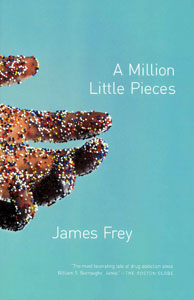
A Million Little Pieces – James Frey

If you're Oprah, don't read this. I have had this book targeted on my shelf for ages and have long been debating my near-term To Read List so that it may be included. I do not know why I kept pushing it off, but I have finally come around to read the biggest story of the year 2007!
I enjoyed it, it had some great stuff to offer. It also had some stuff that buggered me. In all, though, I am glad I finally took the time.
It starts out without giving the reader any sort of back story. Just a drunk/drugged out junkie going through a bit of withdrawals maybe that force his breakfast, lunch, and dinner to be poured out all over his clothes, sopping them no matter where he may find himself. Turns out his parents picked him up at the airport and are delivering him to a rehab facility, the best in the country.
He is inexplicably shitty. Not just covered in vomit, and later his own poo, but because he has no interest in getting better. He is shit, just totally burned out from crack and alcohol and glue and gas and anything else. I was almost disappointed at the things he has left out that could have also worked to get him high. Like Pledge. Or fingernail polish.
He is also told that he is in such horrible shape, and his body is rejecting sobriety through withdrawals so vehemently, that he will literally die the next time he hits the crackpipe. Pretty damn sure, at least. Sure enough to say that if he goes out into the world he will be dead within days. And as if this weren't shit enough, he has to get a couple fillings and root canals because he has not exactly taken care of his Chiclets during his stint as a Whitney Houston impersonator. The catch here is that because he is undergoing treatment for substance abuse, he has to do it without any help from anesthetics or pain killers. Having your ass-rapist shout “I'm going in dry!” behind your back comes to mind.
So that's him. But to counter all of this, he has a heroically awful, anti-hero personality. He is unequivocally fierce, with a stubbornness and temper that set up incomprehensible violence and cataclysmic meltdowns. His stubbornness is also so deeply rooted that he absolutely refuses, at all levels, anything to do with the Twelve Steps. “They won't work on me,” his mantra reminds his captors throughout. We need no reminding, because we get it the first fucking time he says it.
That is really one of the very few things I disliked about the book. The repetition. The repeating of word or words. Mostly word. Repetition. Repeating. Repetition. Repeating.
Repeating.
Repeating.


Repeating.
Repeating.
Repeating.
See how annoying that is? It happens, and happens often in this book. But I gritted past it. It wasn't “I'm going in dry!” level of unbearable.
The other thing I disliked was the bit about the Catholic Priest in the end. Seemed unnecessary. We get it, dude. You are a badass and no one messes with you. Especially when you were high. Got it. You don't have to lay down how tough you are or slip one in at the end about how nobody crosses you.
I really do feel like it completely matters not – as in zero part of me cares – whether this book is factual or a fictional biography. I do not think it affects the reader's experience of it one bit. I went in not caring and came out not caring, with no opinion on how much I would be affected if it is 99% true or 1% true. Point being, Oprah is a twat. I believe she believed everything she was reading was factual, then berated James Frey simply because its not being completely factual made her out to look a fool. Don't she know?

Wednesday, March 27, 2013

Dandelion Wine – Ray Bradbury


First off, I’d just like to say that if you are reading this blog and you are not a Ray Bradbury fan, then kindly fuck right off and close this browsing window right this instant. He is one of the few authors I can apply the term “electrifying” to.  He dazzles. He makes me wonder at how great writing can be. And he makes me feel ashamed that I do not appreciate him enough. I own many books of his, several I have thoroughly enjoyed, some I am yet to read, and his short stories sit in a rather large volume on my shelf, unmolested, much to my dismay but entirely my own fault.

Many authors bring many different styles, and I have reviewed a large portion of my favourite authors on this blog: Neil Gaiman can write circles around the reader with a very “that’s exactly how I feel!” sense that comes to mind when he is read; Frank Herbert has a quality of delivering incredibly well thought out, unique plot-twisted and intense epics; Stephen King can wrap popular culture around a jagged, rusty blade of a storyline and stab it violently towards your eyes; Orson Scott Card will generally find the qualities of life you enjoy and use them as leverage to tear down a main character until he is the exact opposite of everything he is allegedly standing for; but Ray Bradbury remains un-trivialised on my blog. Let us change that, shall we?

He is, to me, what happens when incredible writing meets the everyday observation and is sprinkled in with a very modest, un-voluminous yet extremely powerful darkside. He does not dance around in his own cleverness the way Neil Gaiman does, yet they are very similar to me. He also does not bathe the heroes/heroines in despair quite the way Herbert or Orson Scott Card would, but I can see the relations and inspirations between them all.

Dandelion Wine represents to me a complete novel that fulfills all that I felt The Martian Chronicles lacked. Understand they are completely different books with nearly nothing in common. But both are novels compiled of essentially independent short stories tied to a central location/setting. I loved The Martian Chronicles, loved how it painted humans and our relationship with a new culture that is more of a state of consciousness than a simple second sentient race. But it lacked ringers. Stories that made you put the book down and take a few paces around the room, taking time out to appreciate the experience.


Dandelion Wine does not lack these moments. I do not feel I need to get specific, both for the sake of not spoiling anything for readers of the blog who have not yet read the book as well as for those of you who may have felt the way I did only with different chapters, but this book had individual stories of supreme brilliance.

Whether it was a simple description of the atmosphere one feels when in the prime of summer; the dread of seeing summer’s end; the thrill of scaring one’s self; the fear/acceptance of death and celebration/acknowledgement of life; everything seemed to be so clever and extremely relatable in the analogies and descriptions. In the end, I felt I lived through that Midwestern US summer of 1928 with Douglas and Tom in Illinois.

Whereas authors like Gaiman can be polarizing with their cuteness and subsequent filth in times of comic relief setting the stage for a quick, dark surprise, I felt like Bradbury simplified things in this book. Which serves well as much of the story revolves around two young boys, one a teenager and his brother a ten-year-old. Together they fantasize about the endless possibilities of new shoes. They philosophise and write down everything they learn and categorise human behavior as something “traditional” or “new”, something I found highly advanced for kids but was jealous of their cleverness; not because I could never think of that but because, in my experience, brothers tend to have a mutual let’s see what the riskiest thing we can do/dumbest lie we can tell/most dangerous behavior  complex. Not always, but two young males usually push each other in much the same way as Douglas and Tom, only in a direction that is less productive. So that was cool.

Friday, January 11, 2013

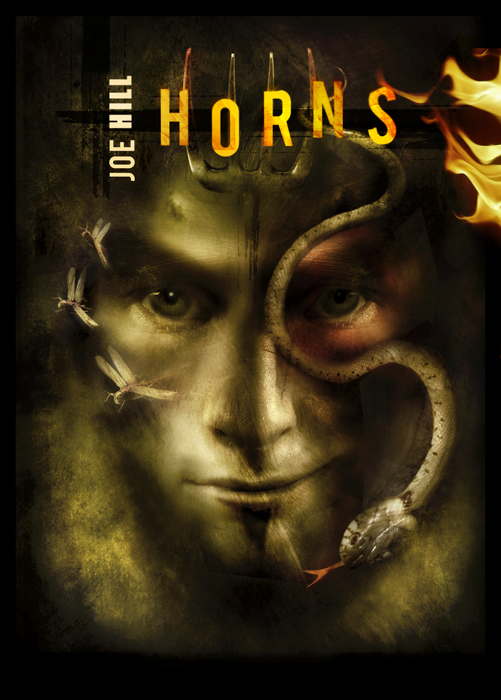
Horns - Joe Hill


I was discussing this book with a friend before I was finished. A dangerous game, sure, but I am always sure to mention I am unfinished with it when I have such talks. And my friends are decent enough people not to ruin it with a devastating spoiler. But she told me she really loved this book, and I said “yeah, it’s pretty good. I mean, as far sex murderer stories are concerned.” She responded with “but it’s so much more than that!” and I honestly didn’t feel, at that point in the story, that it was. Well only a couple of chapters after thinking that horrible thought, there was a majour turning point in the book. I got hit like I’d insulted someone’s mother with a twist I didn’t expect. And not just a plot twist, but one that changes what you feel the story is really trying to convey. It was beautiful. I mean, tragic, and I wanted to cry or take shots or break something, or maybe do all that at the same time, but it was still a very moving moment in the book.

And it is in regards the most important topics with which one can concern his/her self: life, death, and love. Life is no guarantee, but once it is obtained it is your right to keep it, and let others keep theirs. Death can only come once life is granted, and will follow life where ever it may exist. Love, unfortunately, is no guarantee either, and the worst thing to think of is people who experience life until death but never get to experience, or exercise, their right to love. And dying before one can experience love is the greatest crime of all for humanity, in my opinion.
This book takes all of that and, instead of elaborating on it, concentrates it into one vicious strike to your heart. It happens all in one moment. One moment realized after the person everyone loved has been dead for some time. It is truly tragic but truly wonderful.  I really cannot stress that enough.

There is also a very King family influence, and much of the book can be looked at as being written by “Stephen King’s son”. There is that lovable, cynical charm and the dirty, nasty secrets everyone holds within with hidden evil, dark desires that mostly revolve around sex or violence, or violent sex.


But even with that, he is still a unique author, and the book is great on its own, regardless of the fact that you might think, at many different points, it seems like something written by a young Stephen King. “Huh, I could imagine a universe in which the guy that wrote The Dead Zone also wrote this book” I said to myself on more than one occasion. Like, for example, when he touches someone and knows everything about them.

I did find a few faults with the book, I think the plotline of illness making people turn into real assholes is a common enough issue that he may write about it, but not so common that it is on the level of common knowledge that everyone turns into a wicked person when they are ill. I also felt there was some really good irony when he had his horns and people were coming out with these horrible secrets, but sometimes they would act upon their desires with the removal all inhibitions (the true effect of his horns) but there was never any follow-up as to what resulted from people making good on their horrible actions.

Really look forward to more from Joe Hill though. This story had a very “early stages of a great author” feel too it, not a perfect but still very good, and I hope he only improves with time. But then again, he is Stephen King’s son, so who the hell knows.

Thursday, November 1, 2012

Dying Inside by Robert Silverberg


With the exception of Blood Meridian and maybe John Dies at the End, at least in terms of plot, I have had the fortune of reading really amazing books lately. Just think: Lucifer’sHammer, Alvin Maker Book One: Seventh Son, Destination: Void, Pavane (review out soon), and Invitation to a Beheading before that (I should also say here that I do not necessarily post reviews in the same order in which I read. Do not be annoyed, however! For I also do not speak in the order my thoughts come out. It is quite natural for me to do it this way). I’ve had it good lately. Especially in the Science Fiction department; most of which are books from another era and are regarded as classics, or “books I should have read by now,” but I am enjoying catching up on all these greats. Robert Silverberg, more famous for being a short story writer, whose novels A Time of Changes and Nightfall (co-authored with Isaac Asimov) I have already enjoyed, really blew me away with Dying Inside.

It is a difficult one to explain, and the easiest way I can put it is that if you have ever read The Time Traveller’s Wife, it is similar to that in many ways: tone, character development, a few overlapping plot lines that the hero’s power creates and makes awkward; but written by a man. Oh yeah and there’s lots of sex in both books. Big plus there on both of them.

David Selig has the power to read minds…always has. He was born with it. Not in a super power sort of sense, but in an odd way that seems basic to him. He has had this power for so long he sort of forgets how unique it is. It makes him a pain to deal with for normal people. Ruins relationships. And growing up, he didn’t even know he was the only one who possessed such a power, just figured everyone could do it.

In fact, a brief chapter on him growing up turns out to be one of my favourite scenes in the entire book. As a young man he is asked to see a psychologist because his parents worry so much about him not fitting in at school. He answers all of the psychologists questions honestly at first, but as the interview moves on, the boy picks up things that the scientist finds very interesting, specifically things about “pee- pees” and “tushies” and when he sees how seriously the man locks onto those keywords by reading the psych's mind, whilst quietly but frantically taking notes, the boy expands upon them and then steers everything back to those particular references. He eventually adopts the scientist’s own technical terminology when referring to these parts, and this move, playing a fun game with the man’s brain, is dangerous but also innocent because the young man honestly doesn’t know any better.

There are actually many great scenes like that though, and some people have such hostile personalities that it is difficult to harness them and probe their mind, as though the energy locked inside from contained emotion makes it treacherous for his self-described mental tendrils to probe. Such is the case with one of the athletes, a 6’9” black basketball player he meets and tries to work with.


Not only does this danger feel like real danger, but it is compounded by the fact that, as the book’s title implies, his power is slipping. It is a difficult journey about how he manages, and is nice when he talks about how he used to be when he had it working well. He could use it to hone in on some girl in his crowded apartment and within the evening, bang her; then work part time on Wall Street when he needed cash and make unbelievably good calls on stock options before big deals were announced. Which is probably what we would all do, right? I mean, just think of it: if you had that power, not only the basic “what would you do with it” questions should be asked, but also “how would your life turn out?” If you get bummed out by how generally shitty people are, it is only going to get worse if you can read their thoughts. At least that’s what I feel like, and why I feel bad for poor David Selig. It’s an interesting concept, for sure.

Even more interesting to me though is how one copes with losing such a power! Sure, we've all fantasized about the ability to fly, stop bullets with a force field we can control, see through girl's clothes and such, but have we ever thought how we'd cope if we were born with such a talent, never really learning to appreciate what it must be like not to have it, and then gradually begin to lose it? It's kind of like sight. Or memory. Or Giving a Fuck. Or having hair on my head, when you think about it.


But David never gets over how awkward having the power is. How devastating it is to his relationships with family, friends, lovers and bosses. So maybe it fading away is a good thing. I find myself feeling really bad for him at times, and I honestly think Silverberg makes him a very believable, relatable character with a power that just doesn’t serve someone like him practically.

One other thing I would like to include is a sort of similarity I saw between it and Time Traveller's Wife on sex. I don't think he ever time travelled during sex, in Time Traveller's Wife, I mean. And I may have my facts wrong, but I remember it as being a reason to bang constantly. He also went jogging a lot, because he also tended not to travel during jogging. But lots of sex and the power was at bay during sex, I think I'm remembering that right. Anyway, David Selig can probe a girl's mind during sex, and really get inside her head to know everything she's experiencing (I mean talk about all I would be doing with that power if I had it!) until the moments nearing orgasm, when there is just too much energy for him to sustain a presence inside. He is then ejected, forcefully, from her mind and emotions and can feel nothing through her when she actually climaxes. I thought it interesting both books involve some breaking of this supernatural power through sex.

In summation, a very fun book and if you’re not a Robert Silverberg fan yet, and only care to read maybe one of his books, I say make it this one. The man has range, it is much different than A Time of Changes and especially Nightfall, but I’ll leave Nightfall alone and recommend it to those who are doomsday sci-fi fans.