Popular Posts

Showing posts with label Gaiman. Show all posts

Monday, September 16, 2013

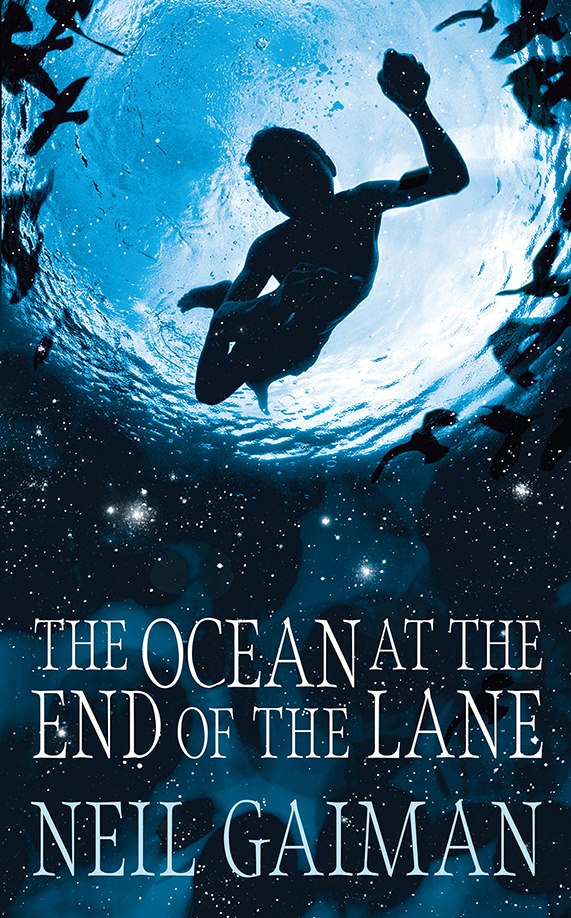
Ocean at the End of the Lane

So Neil Gaiman went and wrote another story for children! Then another one, about a child, that I sort of had the impression might be a children’s book in the same light as His Dark Materials are children’s books.


It is about a man who is attending a funeral and makes a stop at the house on the end of the lane where he grew up, remembering his friend Lettie who had an ocean in her small pond. He then flashes back, and the story takes away to the time when he was seven, remembered by referencing his seventh birthday party – a party in which nobody showed up and he took his books and his Batman figurine upstairs to his room. He then learned that he was to be moved from his room to make way for a new tenant, as money was tight, and a South African opal miner shows up, runs over his cat, gives him a stray to make up for it, then steals his father’s Mini and kills himself in it. This event brings about a creature from another dimension, and she throws money at people and tries to hurt them whilst giving them things they desire. Lettie and the young man venture into the other realm to make sure the creature no longer throws money at people, and it uses the young boy as a door to cross into our realm. The monster shows up as an attractive young nanny to take care of the boy and his older sister, very much in a creepy Merry Poppins sort of way, if Merry Poppins were a babe, and named Ursula Monkton. Ursula puts everyone else into some sort of trance, becomes vindictive and nasty towards the boy, then gets his non-violent father to try and kill him by drowning him in the tub, then has sex in the study with the boy’s father as he escapes, then gets eaten by ravenous shadow-figures that are sort of like birds.


Pretty cool children’s book, if you ask me. I would let my kids read it. But not before they finished His Dark Materials.

I liked it, not just for all the reasons I mentioned, but because the story telling was so good. Gaiman really never ceases to surprise me with his quickness in taking a story from one direction and turning it on its head. This one had a lot of elements from others, namely Neverwhere, Graveyard Book, and Stardust, for me. Neverwhere, in the sense that a person visible and knowable in our world can become a door to the other world, which is not just a clichĂ© fantasy but some sort of fucked up imagination I probably would not voluntarily visit that exists in Gaiman’s mind. And Graveyard Book because of the way the Hemstock family are all liminal figures who understand and can determine who and what goes in and out of each realm and orchestrate maneuvers that keep everything in their proper place within the two. But, because they are liminal figures (which many of my favourite characters throughout literature often are), they share nothing about how they are able to do these things.


Also similar to Stardust is that misdirection, where Gaiman builds an air of children’s fantasy story-telling, letting you think that you may be reading a bit of a kids’ book, then presents fucking. And not “proper British sex,” either, but babes fucking dudes. It always gets me!
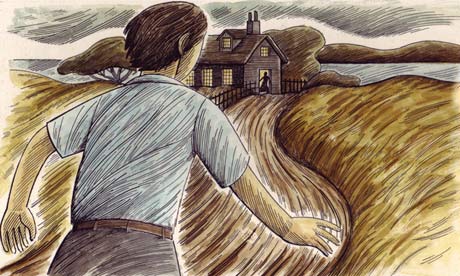
 Another, this time unfortunate, thing I realized when I read this book, is that Gaiman drew many of the background events to set up the plot from his own life. Which tend to be pretty fucked up. I say this is unfortunate, because the story-telling is so good that I finally came to the realization that all great authors pour into their works some elements of their own background, and the darker their past, the better the book. So events such as him climbing his drain pipe growing up, having a tenant who killed his kitten, stole his dad’s Mini and killed himself in it, being the only one present at his seventh birthday party, and still being excited to go read books and play with Batman toys, these things all make for a dark past and a great story. I was pretty regular, and pretty damned spoiled as well. I am therefore incapable of entertaining you all with something so inspiring.


Wednesday, March 27, 2013

Dandelion Wine – Ray Bradbury


First off, I’d just like to say that if you are reading this blog and you are not a Ray Bradbury fan, then kindly fuck right off and close this browsing window right this instant. He is one of the few authors I can apply the term “electrifying” to.  He dazzles. He makes me wonder at how great writing can be. And he makes me feel ashamed that I do not appreciate him enough. I own many books of his, several I have thoroughly enjoyed, some I am yet to read, and his short stories sit in a rather large volume on my shelf, unmolested, much to my dismay but entirely my own fault.

Many authors bring many different styles, and I have reviewed a large portion of my favourite authors on this blog: Neil Gaiman can write circles around the reader with a very “that’s exactly how I feel!” sense that comes to mind when he is read; Frank Herbert has a quality of delivering incredibly well thought out, unique plot-twisted and intense epics; Stephen King can wrap popular culture around a jagged, rusty blade of a storyline and stab it violently towards your eyes; Orson Scott Card will generally find the qualities of life you enjoy and use them as leverage to tear down a main character until he is the exact opposite of everything he is allegedly standing for; but Ray Bradbury remains un-trivialised on my blog. Let us change that, shall we?

He is, to me, what happens when incredible writing meets the everyday observation and is sprinkled in with a very modest, un-voluminous yet extremely powerful darkside. He does not dance around in his own cleverness the way Neil Gaiman does, yet they are very similar to me. He also does not bathe the heroes/heroines in despair quite the way Herbert or Orson Scott Card would, but I can see the relations and inspirations between them all.

Dandelion Wine represents to me a complete novel that fulfills all that I felt The Martian Chronicles lacked. Understand they are completely different books with nearly nothing in common. But both are novels compiled of essentially independent short stories tied to a central location/setting. I loved The Martian Chronicles, loved how it painted humans and our relationship with a new culture that is more of a state of consciousness than a simple second sentient race. But it lacked ringers. Stories that made you put the book down and take a few paces around the room, taking time out to appreciate the experience.


Dandelion Wine does not lack these moments. I do not feel I need to get specific, both for the sake of not spoiling anything for readers of the blog who have not yet read the book as well as for those of you who may have felt the way I did only with different chapters, but this book had individual stories of supreme brilliance.

Whether it was a simple description of the atmosphere one feels when in the prime of summer; the dread of seeing summer’s end; the thrill of scaring one’s self; the fear/acceptance of death and celebration/acknowledgement of life; everything seemed to be so clever and extremely relatable in the analogies and descriptions. In the end, I felt I lived through that Midwestern US summer of 1928 with Douglas and Tom in Illinois.

Whereas authors like Gaiman can be polarizing with their cuteness and subsequent filth in times of comic relief setting the stage for a quick, dark surprise, I felt like Bradbury simplified things in this book. Which serves well as much of the story revolves around two young boys, one a teenager and his brother a ten-year-old. Together they fantasize about the endless possibilities of new shoes. They philosophise and write down everything they learn and categorise human behavior as something “traditional” or “new”, something I found highly advanced for kids but was jealous of their cleverness; not because I could never think of that but because, in my experience, brothers tend to have a mutual let’s see what the riskiest thing we can do/dumbest lie we can tell/most dangerous behavior  complex. Not always, but two young males usually push each other in much the same way as Douglas and Tom, only in a direction that is less productive. So that was cool.

Tuesday, December 18, 2012

The Man Who Was Thursday – A Nightmare


Remember that kids. A nightmare. It is important.

So G.K. Chesterton was a big guy who threw his weight around and liked to use rhetoric to argue with people, on all points concerning mankind and society, until he died? A man after my own heart. Truly. I picked this book up because I had found it and subsequently purchased a copy after I learned it makes its way into Neil Gaiman’s top 10 books. That he has read. In his life! That has some notoriety to it. Not that I would read all books on his list, he described one as a “slow version of Dickens’ Bleak House” and I nearly fell over with exhaustion just imagining it.

And some background on Gilbert Keith: He was a massive man, joked about it, wrote a lot about politics and religious apologetics, also wrote poetry, mystery, fantasy and spent the rest of his time arguing philosophies with George Bernard Shaw. Shaw was a modernist, and Chesterton an orthodox Catholic. But they had very spirited bouts and always remained great friends. Wish we could do that more now days. I mean I can, I don’t care who believes what, just as long as we all are good humoured about it and the views of others.

Anyway he wrote The Man Who Was Thursday as a detective novel where people are recruited into an anti-anarchist wing of Scotland Yard’s detective agency and must use their wit to infiltrate the ring of anarchists known to be amongst commoners in London, but operating out of the London Underground. The plot follows Gabriel Syme, who outwits a man named Gregory, who is an anarchist trying to prove to Syme that they are a real force to be reckoned with. Syme must protect his own identity, however, and accomplishes this by suggesting Gregory isn’t a good enough anarchist at a secret meeting Gregory drags him to where they are voting on a new leader of their local chapter, which happens to be a position in the council of 7 and is code-named Thursday. He uses leverage to speak to the council and gives such a great speech, condemning Gregory, that he wins the vote. Syme is going to be Mr. Thursday!

 
Once at these meetings of the 7, Syme learns something awful, however. That they no longer believe in keeping anarchy a secret, and instead believe the best way to appear harmless if for the heads to appear right out in the open. Has to make the detective nervous. What’s worse? (SPOILER ALERT!) Syme learns quickly that five of the seven member are also secret detectives like him, policemen from Scotland Yard sent to infiltrate the Council.

Even more mindblowing is that they learn all this as they come together, and figure out that a real anarchist revolution is going on without them, whilst they are busy hunting each other down in the woods trying to point out members that are actual anarchists. Turns out none of them are! And the anarchists move on with an insane plan, leaving them all hopeless and desperate.

In the end, Sunday is revealed as Gregory, only masked, and tells them all that his people are the ones who have suffered, hence the revolt. But good Syme responds with a “you don’t know what I just went through, what I experienced, what I suffered” speech and caps it off with a quote from Jesus: “can ye drink of the cup that I drink of?” Bravo G.K. Nightmare over. Book end.

I thought it was a nice, short and simple story with great post-Victorian British humour and rhetoric. I don’t know when I aged 120 years and started enjoying that stuff, my guess is sometime after my first go at Dickens’ Bleak House, but I really do like that stuff. If it’s not for you, it’s not for you. Otherwise, it is a fairly entertaining nightmare.

Tuesday, June 26, 2012

Jonathan Strange and Mr. Norrell (with minimal spoilers! If any...)


Sorry for not getting this out sooner. I thoroughly enjoyed Jonathan Strange and Mr. Norrell but life got in the way of my blogging with a terrible accident that ended up costing me many extra, very late hours and weekends at the office. So I’m just resuming some sense of the normal status I knew before the accident now.
This novel is Susanna Clarke’s first, shamefully, and was on our radar for the book club as well as talked about when I visited a website showcasing Neil Gaiman’s Top 10 favourite books, if that sort of list means anything.
It is broken into three volumes, “Mr. Norrell,” concerning the curmudgeonly snobbish and angry old Mr. Norrell who is trying to monopolise English magic; “Jonathan Strange,” a less-than-heroic hero who acts, figuratively, as a sort of knight in shining armor but is really just a nerdy, unhandsome, very studious and quicklearning magician on the rise; concluded by “John Uskglass,” the semi-mythical hero-king and founder of English magic.

This book’s depth and range of humour and magical is always engaging and tends to focus less on the conjuring of magic, like Harry Potter (as I understand it, anyway), and in fact skips over that entirely in most parts, and instead focuses on the magic itself, its manifestations and ends. The creations by Mr. Norrell in the first book, what he is able to master and prove to innocent citizens and enemies of the English alike, are spells or some other conjuring that is kept entirely away from the reader, which is a very Norrell quality. He absolutely hates sharing magic.
And about the enemies, this book takes place during the world’s conflict with the French, specifically Napolean Bonaparte. I’m not too familiar with that part of history (because I grew up in ‘Merica) but Clarke does an excellent job of making the reader feel comfortable moving with the story and not touching upon trivialities that history buffs would know and semi-educated folk should know. I guess the key there is that I do not get the sense, as a reader, that she is ever talking about something I should have known about.
The conflict with Napolean features some magic by Norrell, but it really is a feature that showcases the badassery of Jonathan Strange. Although his magic helps England prevail, he is a very relatable character. Norrell represents a very shitty mentor and horrible teacher of magic to him, almost like working for a horrible boss, but Strange persists and is a very touted magician in not-to-long a span of studying the art; mostly on his own as Norrell’s weird sense of hoarding all literature and knowledge of magic persists, even when he takes on a pupil. The best thing about his rise is that his explanation to everyone of what he learned is very simple, and that he picks things up because they really are not that difficult and he applies himself, and tries new things when they do not work rather than giving up.
Relatable because I work around many people who go through each day doing the same things with very poor results but because they cannot bring themselves to work around problems and challenge their own way of thinking, they never progress.
Aside from a very British book with a very British sense of humour and propriety, Clarke also weaves a web of lies and deceit that I just couldn’t wait to be resolved. Sure, I had to wait about 800 pages for it all to work out, but it was a fun ride to get there and the plot thickens in a well thought-out way the entire time.
I honestly have no complaints or none that I can recall in regards to this book. To paraphrase a fellow literary assessment club member, the book is like “if Bleak House and an Elizabeth Gaskell novel had a child, and was modern enough to be appreciated by our generation.” Accurate or not, that statement may scare off some potential readers. As well it should, I’m not sure everyone will appreciate this book for all it has to offer as people these days seem not to like books that are this long (to which my Count of Monte Cristo friends and I say you can go fuck yourselves!).

Friday, June 1, 2012

Neverwhere


There has almost been a trend of late of my reading books that are possibly more popular on the screen than in the library. Did not have much in the way of friends, if you can believe it, who had read 2001: A Space Odyssey, even fewer that had the pleasure of enjoying A Clockwork Orange in book format, but the novel Neverwhere seems to be quite popular amongst the US population, at least more popular than the BBC television series by the same name written by the same guy.

And because of something that caught my eye on Tor.com recently in regards to Mr. Gaiman, I decided to do something a bit different with this review. Firstly, the review; then, a response to the article linked here from Tor.com.

Now, to the recap/review of a book I thoroughly enjoyed.


Richard Mayhew discovers a bleeding-to-death Lady Door on the sidewalk as he is being berated by his mega-bitch of a fiancée. He saves her life and is rewarded with a visit from the goons that are out to get her. Once they realise they cannot kill her and he is an accomplice, his life is turned on its side and nobody recognises his existence. This is where the separation between London Below and London Above really starts to take place; Richard is completely ignored and can make a complete fool of himself and no one will notice, except when he gets in their faces and asks them directly, at which point people either do not seem to recall who he is or cannot answer his questions.

When walking downtown he realises a vagrant recognises him, and though this brings him joy it is yet another part of the transition for him to accept that he is now a member of the Underworld, with its Ratspeakers (people who can communicate with rats), feudal system, and lack of currency to sustain the basic needs to continue life in favour of a strange trading system.

Gaiman's talent and charming humour have a way of making these ridiculous obsurdities (which are rationalised as impossible feats at first by Richard, only to have his rationale proven useless as the impossible unfolds) blend into the story seamlessly. The subways filled with a complete court, including guards and court jester; the angel; the walking into London Below by walking into an alleyway and turning around to see what was once behind you is not where you came from; the Bridge; the Markets; it is all a work of fantasy that a lesser author would force in and trip you up, preventing you from being engaged by the story, but it just seems to work when Gaiman is writing it out. Partly because it is silly, sure, but also because it just works in a weird, wild, way.

Richard is a sad and depressing character, not much assertiveness out of him and very reliant on his sad comfort-zone in the modern world. So his reliance on The Lady Door is made more complicated as she tells him there is no going back to the world from which he comes and she is powerless to help him. After a bit of adventure he ends up back with her and proves his worth in a rite of passage that no other Underworlder has passed.

This is where his acceptance into the group is finally realised, and as a hero he can now travel with the Marquis de Carabas and Hunter, the sexy assassin turned body guard, through the labryinth beyond Down Street into the dwelling of the Angel Islington. Turns out his awesome palace is a prison and the key Richard recovered is actually a key to Heaven, but as doom ensues the Lady Door, who can "open anything," has planned ahead and the Door-hunting, vile, venomous assassins Croup and Vandemar along with the fallen Angel are cast out to Bog-knows-where. Richard can move on with his life, and Door and the Marquis can begin uniting the Underground.

I quite like the little twist at the end, as we feel Richard has learned to grow a pair from all of this, and adventure and renown are always worth more than a steady job and a peaceful living situation allowing one to feel secure and in his comfort-zone. Have not watched the series at all yet but I think I will, as the plot and characters are all the exact same and Gaiman had almost just as big a part in its writing as he did the novel.

And now, the message of the tor.com article linked above (which you may already have read, if you are the reading type):

I’ve read a fair amount of Gaiman over the years: was enthralled by Sandman, really liked Good Omens, liked Stardust, thought Neverwhere was OK I guess, flipped through Smoke and Mirrors without much interest, and just this week read American Gods, which had some good bits but overall I didn’t much care for…
[lots of anti-Gaimanian words]
…but at the same time, I genuinely don’t understand what other people are getting out of his work that I’m not. So I ask you: why Gaiman? What about his work do you find so compelling? What am I missing?

Well I actually liked this article because it made me question what I like about Gaiman. I guess I will say that I really enjoy him taking very average, dopey and common people as main characters, adults in their twenties and thirties that are easy for me to relate to, and thrusting them into a world of magic and mysticism and mythical realities, and then observing their reactions. It is almost like these things happened to common folk and we are all just along to observe how they handled it. The mystics and Gods and liminal figures come from a place we might identify as a fantasy world but factor into the lives of people we would see as being more like us. I think that is very enjoyable. Plus, it doesn’t hurt that Gaiman is funny as hell. Not just anybody can crank out comic gold like this shit:
“You've got a good heart. Sometimes that's enough to see you safe wherever you go. But mostly, it's not”
Gets me every time. Anyway, I like the man for many reasons, more than I can coherently piece together here and more than I can incoherently jabber on about with friends after a dozen beers. So read it, or anything else by him, like Stardust or American Gods, if you have time.