Popular Posts

Showing posts with label Anarchy. Show all posts

Monday, September 30, 2013

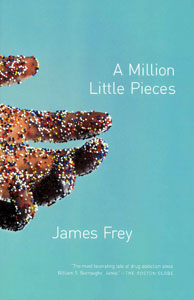
A Million Little Pieces – James Frey

If you're Oprah, don't read this. I have had this book targeted on my shelf for ages and have long been debating my near-term To Read List so that it may be included. I do not know why I kept pushing it off, but I have finally come around to read the biggest story of the year 2007!
I enjoyed it, it had some great stuff to offer. It also had some stuff that buggered me. In all, though, I am glad I finally took the time.
It starts out without giving the reader any sort of back story. Just a drunk/drugged out junkie going through a bit of withdrawals maybe that force his breakfast, lunch, and dinner to be poured out all over his clothes, sopping them no matter where he may find himself. Turns out his parents picked him up at the airport and are delivering him to a rehab facility, the best in the country.
He is inexplicably shitty. Not just covered in vomit, and later his own poo, but because he has no interest in getting better. He is shit, just totally burned out from crack and alcohol and glue and gas and anything else. I was almost disappointed at the things he has left out that could have also worked to get him high. Like Pledge. Or fingernail polish.
He is also told that he is in such horrible shape, and his body is rejecting sobriety through withdrawals so vehemently, that he will literally die the next time he hits the crackpipe. Pretty damn sure, at least. Sure enough to say that if he goes out into the world he will be dead within days. And as if this weren't shit enough, he has to get a couple fillings and root canals because he has not exactly taken care of his Chiclets during his stint as a Whitney Houston impersonator. The catch here is that because he is undergoing treatment for substance abuse, he has to do it without any help from anesthetics or pain killers. Having your ass-rapist shout “I'm going in dry!” behind your back comes to mind.
So that's him. But to counter all of this, he has a heroically awful, anti-hero personality. He is unequivocally fierce, with a stubbornness and temper that set up incomprehensible violence and cataclysmic meltdowns. His stubbornness is also so deeply rooted that he absolutely refuses, at all levels, anything to do with the Twelve Steps. “They won't work on me,” his mantra reminds his captors throughout. We need no reminding, because we get it the first fucking time he says it.
That is really one of the very few things I disliked about the book. The repetition. The repeating of word or words. Mostly word. Repetition. Repeating. Repetition. Repeating.
Repeating.
Repeating.


Repeating.
Repeating.
Repeating.
See how annoying that is? It happens, and happens often in this book. But I gritted past it. It wasn't “I'm going in dry!” level of unbearable.
The other thing I disliked was the bit about the Catholic Priest in the end. Seemed unnecessary. We get it, dude. You are a badass and no one messes with you. Especially when you were high. Got it. You don't have to lay down how tough you are or slip one in at the end about how nobody crosses you.
I really do feel like it completely matters not – as in zero part of me cares – whether this book is factual or a fictional biography. I do not think it affects the reader's experience of it one bit. I went in not caring and came out not caring, with no opinion on how much I would be affected if it is 99% true or 1% true. Point being, Oprah is a twat. I believe she believed everything she was reading was factual, then berated James Frey simply because its not being completely factual made her out to look a fool. Don't she know?

Sunday, June 16, 2013

Ready Player One - by Ernest Cline

What a nerdfest! I absolutely adored this book’s throwback to better times. The 1980’s. Ah, what a time for music, movies, cars, tv programs, and of course, video games. The book is actually set in a dystopian 2040-something era where humans have exploited the Earth to its limits. One of the only things I did not like about this story, as I really liked it overall, was the author’s selling point that “we have used all the oil and mined all the coal and now there’s no energy and the sky is a hazy brown.” No. No no no, you won’t mine all the coal in the next 40 years. There are hundreds of years of reserves in this country alone. And it burns pretty damn clean. My old home of Tucson, Arizona is powered by a giant coal plant that has air around it as clear as anywhere else in that valley. It’s even cleaner than Phoenix, which gets some of its power from a nukular (TM George W. Bush) plant. Coal plants are not quite the smoggy, smokey cloud-factories that are portrayed in commercials anytime a liberal media blasts a right-wing politician for his reluctance to crack down on the Earth-raping coal industry. Politics aside, the setup is a bit rough. We are not working our way out of decent civilisation. We are sort of growing up and growing out as a race, riding the waves of science and technology and human understanding. But this takes a hardline approach for outlining the future as a very dystopian, poverty ridden, overpopulated and almost silly universe; like the setting of the movie Idiocracy. No wars, just dumb people getting dumber. Once that is all over, however, the book is extremely enjoyable.

It starts out with 80's references that we are all pretty familiar with, and I was almost a bit disappointed that its references would all be of the popular variety: Highlander, Back to the Future, Sixteen Candles, Def Lepard, Space Invaders, things that pretty much everyone knows. But that is only the beginning, as the book moves along I found myself catching less and less of the references. 80's cartoons, for example; I am only familiar with the majour ones, like Voltron and Transformers. These are sort of treated as the "pop-culture" of cartoons and Cline glides past them and focuses on some pretty obscure shit. Mainly Japanese shows I have never heard of. It was very enjoyable, however, to test the trivial understanding of the 80's and try to see how familiar all the names, shows, characters, and video games (the glorious, 8bit, 2D videgomes) are to me.
Do not misunderstand me, the nostalgia of this book is the primary source of entertainment that I drew from it. But it has general nerd themes I can enjoy. Like the main character enjoying Youtube style videos of cute geeky girls playing their ukuleles. Who has not geeked out to that? And the material related to a futuristic gaming console and its virtual reality setup that is a unique take on tired theory. There is also a shout-out in there to current real life nerds like Wil Wheaton and Cory Doctorow. 

These are enough for me to say it was a book worth my time, but the story itself – again, once you get passed the "we've mined and sucked all the resources out and burned them all, oh no!" bit – is truly fantastic. The antagonistic Sixers and their mega-corporate organisation conducting attacks and putting the users in very real danger was exciting. The glimpse of their world and their processing of employees and indentured servants reeked of the movie THX-1138, a very enjoyable dystopian sci-fi film that also happens to be George Lucas's first film. 
Above all, a love of classic arcade and 8-bit video games, the ones that pre-date my childhood but I still happen to be familiar with, is the very best part of it all. The videogame industry has been in a bit of a tailspin since a time not long after the Wii came out, giving the impression that better graphics are not necessarily what everyone wants…people just want a fun game. And the games of that era were just that. Further clues about the videogame industry’s struggles comes from how the rise of the mobile device has been a huge blow to their profits. People do not need to spend USD 300 to 500 for an entertainment system and another USD 40 to 60 for a game when they can get a little bit of fun here and there on their phone. And what do I play on my phone? Nintendo, SNES, and arcade games; exactly what Ernest Cline is celebrating in this one.

Tuesday, December 18, 2012

The Man Who Was Thursday – A Nightmare


Remember that kids. A nightmare. It is important.

So G.K. Chesterton was a big guy who threw his weight around and liked to use rhetoric to argue with people, on all points concerning mankind and society, until he died? A man after my own heart. Truly. I picked this book up because I had found it and subsequently purchased a copy after I learned it makes its way into Neil Gaiman’s top 10 books. That he has read. In his life! That has some notoriety to it. Not that I would read all books on his list, he described one as a “slow version of Dickens’ Bleak House” and I nearly fell over with exhaustion just imagining it.

And some background on Gilbert Keith: He was a massive man, joked about it, wrote a lot about politics and religious apologetics, also wrote poetry, mystery, fantasy and spent the rest of his time arguing philosophies with George Bernard Shaw. Shaw was a modernist, and Chesterton an orthodox Catholic. But they had very spirited bouts and always remained great friends. Wish we could do that more now days. I mean I can, I don’t care who believes what, just as long as we all are good humoured about it and the views of others.

Anyway he wrote The Man Who Was Thursday as a detective novel where people are recruited into an anti-anarchist wing of Scotland Yard’s detective agency and must use their wit to infiltrate the ring of anarchists known to be amongst commoners in London, but operating out of the London Underground. The plot follows Gabriel Syme, who outwits a man named Gregory, who is an anarchist trying to prove to Syme that they are a real force to be reckoned with. Syme must protect his own identity, however, and accomplishes this by suggesting Gregory isn’t a good enough anarchist at a secret meeting Gregory drags him to where they are voting on a new leader of their local chapter, which happens to be a position in the council of 7 and is code-named Thursday. He uses leverage to speak to the council and gives such a great speech, condemning Gregory, that he wins the vote. Syme is going to be Mr. Thursday!

 
Once at these meetings of the 7, Syme learns something awful, however. That they no longer believe in keeping anarchy a secret, and instead believe the best way to appear harmless if for the heads to appear right out in the open. Has to make the detective nervous. What’s worse? (SPOILER ALERT!) Syme learns quickly that five of the seven member are also secret detectives like him, policemen from Scotland Yard sent to infiltrate the Council.

Even more mindblowing is that they learn all this as they come together, and figure out that a real anarchist revolution is going on without them, whilst they are busy hunting each other down in the woods trying to point out members that are actual anarchists. Turns out none of them are! And the anarchists move on with an insane plan, leaving them all hopeless and desperate.

In the end, Sunday is revealed as Gregory, only masked, and tells them all that his people are the ones who have suffered, hence the revolt. But good Syme responds with a “you don’t know what I just went through, what I experienced, what I suffered” speech and caps it off with a quote from Jesus: “can ye drink of the cup that I drink of?” Bravo G.K. Nightmare over. Book end.

I thought it was a nice, short and simple story with great post-Victorian British humour and rhetoric. I don’t know when I aged 120 years and started enjoying that stuff, my guess is sometime after my first go at Dickens’ Bleak House, but I really do like that stuff. If it’s not for you, it’s not for you. Otherwise, it is a fairly entertaining nightmare.

Tuesday, August 28, 2012

The Waste Lands - The Dark Tower: Book Three


Book III picks up essentially where Book II leaves off, plus an intro by Mr. King really recaps everything that has happened in the first two books well. We start out with Eddie Dean, Detta/Odetta-now-Susannah/Mrs. Eddie Dean, and the hero Roland as they reach the forest and have moved away from the coast lines with giant evil fucking lobsters. Now their diet consists of deer meat rather than lobster meat. So good for them.

The pace of this book is entertaining for me. It starts out with a brief “here we are now, moved on from the lobstrocities,” and then enters the “Holy shit, a hostile giant grizzly robot bear with a parasitic disease, headed right for Eddie!” This happens, of course when Susannah is learning to Gunsling (I’ll note here that both her and Eddie learn the craft) and she ends up being able to shoot the fucker right in its fucking robot antenna. Cool shit.

From here the book continues with Roland being haunted by a new take on alternate realities, which can sort of be compared to time travel paradoxes. Being a huge, huge nerd for time travel paradoxes, it’s cool to see how this variant unfolds. Roland met the boy Jake in Book I, and he and Jake bonded a close relationship up until the kid, terrified of being left for dead in that world, basically said “ah fuck it, I can tell the Tower means more to you than this. Go on.” Since then Roland had felt very guilty. But the moment Jake left his current world (which is essentially our world circa 1987) for whatever fucked up place he met Roland, he was dead. Dead because the Man in Black or Jack Mort pushed him into a car on the streets of New York and he came to, post-mortem, alive and well (somehow), to meet the Gunslinger and hunt down The Man in Black. Confusing, I know, but when you are reading Book III it all makes sense.

Anyway, what’s cool is how haunted and mind-blowingly mind-fucked Roland now is. He explains that when he was in control of Jack Mort (in Book II), he saw him about to commit the act of pushing Jake in front of the car and thus, killing him, which sends him to meet Roland back in Book I. But since Roland saved him from this fate, meaning he did not die there, he never technically got sent to Roland’s world; meaning they technically never met. So his mind splits between a reality that says “the boy was saved, of course he never died and went to your world” and another that says “but you met him, he was there.”


Roland tripping balls on this helps add to the nightmare landscape King creates in this book. Dreams, both crazy nightmarish and important event-foreshadowing-signals dreams, are involved in making the book read like a scene from a Freddy Kruger nightmare world in which the landscapes and monsters seem just as impossible as the notion of escape. I was really digging it. Then Jake came into the story, as he suffers from not only the same paradox as Roland, but much worse because his involves himself being killed, blood and trauma and all. This not only makes things interesting for me, but the pace continues, all the way up until we all cheer Jake onto the gate that brings him into the Gunglingers’ world; every one antsy, giddy and hollering for the little fucker to escape the monster made of plaster (I also had trouble envisioning it, don’t worry) and Susannah fucking a demon.

The demon fucking is actually what I use as the turning point. That is about where things got weird. Once they are all together, things get a little slower paced. The city and the bridge and the people and villains they stumble upon, from here on out, are not really from the genre the story seemed to be carrying me. There are post-apocalyptic settings, with worlds and universes mixed together like Jake mixing in with Roland in Book I, and that’s all great, don’t get me wrong. But something about the sophisticated fallout shelter and the hyper advanced train co-mingling with idiots who murder each other every hour and our Clint Eastwood figure gunslinging seemed to branch out in too many directions. Plus I wasn’t as excited to see Roland with a six-shooter blasting people in a fallout shelter and running for a monorail as it electrocutes people in front of him as I thought I was.

The book ends with them headed through the real Waste Lands, which are one of the most nightmarish environments ever imagined. I really respect the way he creates the world that is passing underneath the gang as they travel on a super evil, badass monorail.

What I liked most about this book is not just his ability to talk about nightmares and nightmarish worlds, though. It was two other important things:

  1. The ability to relate to characters that are kids, and make you feel the same emotions you felt when you were a kid, whether it be petrified fear of something that scared the bajesus out of you, or that awkward feeling of being near people who are complete assholes and you were unable to understand a world of such blatant assholery.
  2. The snark, the comic relief, the King-humour. It is that little, tiny bit of dirty charm he offers and it works really well in this story.


Sometimes it is too cheesy, sometimes it adds nothing to his novels, but in this book it just works. The subtle humour that is worthy of a reader’s smirk is a good quality, and it makes him a great, cynical ass. As opposed to a cynical assHOLE, like me.

Interestingly enough, Stephen King’s Dark Tower series seems to coincide with shit that happens in real life that makes me think, “if Ibelieved in coincidences, this wouldn’t mean shit, but since I don’t, this is pretty weird.” So as the book concludes with Blane the Mono taking them over some weird ass freaky world, a friend (not a reader, I might add, and certainly I don’t keep people up on what I’m reading, so this is out of the blue) posted this on my Fbook wall:


Creepy? Yup.

I would say overall it was very good until things went downhill from the point they brought the other one into the world. The Demon fucking, which I later told a friend I referred to as the gift that keeps on giving, since it happened in the first one and also since Susanna was certain she was pregnant around the same time (weird, isn’t it?), was difficult. Not difficult in terms of “handling it,” – which it was, that demon was packing – but difficult to follow in a world that worked. This just did not seem like something that belonged. Seemed more like the Stephen King I have come to know and like only a little bit.

The book generally had a downhill cheesiness from there for me; but again, because I enjoyed the first half so much, I would still say it is a very enjoyable read. Just don’t get your hopes up after the first half. The momentum and general awesomeness does not maintain its thrilling pace.