Popular Posts

Showing posts with label McCarthy. Show all posts

Monday, September 30, 2013

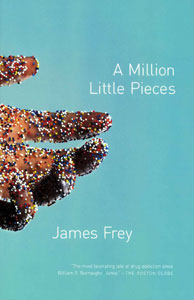
A Million Little Pieces – James Frey

If you're Oprah, don't read this. I have had this book targeted on my shelf for ages and have long been debating my near-term To Read List so that it may be included. I do not know why I kept pushing it off, but I have finally come around to read the biggest story of the year 2007!
I enjoyed it, it had some great stuff to offer. It also had some stuff that buggered me. In all, though, I am glad I finally took the time.
It starts out without giving the reader any sort of back story. Just a drunk/drugged out junkie going through a bit of withdrawals maybe that force his breakfast, lunch, and dinner to be poured out all over his clothes, sopping them no matter where he may find himself. Turns out his parents picked him up at the airport and are delivering him to a rehab facility, the best in the country.
He is inexplicably shitty. Not just covered in vomit, and later his own poo, but because he has no interest in getting better. He is shit, just totally burned out from crack and alcohol and glue and gas and anything else. I was almost disappointed at the things he has left out that could have also worked to get him high. Like Pledge. Or fingernail polish.
He is also told that he is in such horrible shape, and his body is rejecting sobriety through withdrawals so vehemently, that he will literally die the next time he hits the crackpipe. Pretty damn sure, at least. Sure enough to say that if he goes out into the world he will be dead within days. And as if this weren't shit enough, he has to get a couple fillings and root canals because he has not exactly taken care of his Chiclets during his stint as a Whitney Houston impersonator. The catch here is that because he is undergoing treatment for substance abuse, he has to do it without any help from anesthetics or pain killers. Having your ass-rapist shout “I'm going in dry!” behind your back comes to mind.
So that's him. But to counter all of this, he has a heroically awful, anti-hero personality. He is unequivocally fierce, with a stubbornness and temper that set up incomprehensible violence and cataclysmic meltdowns. His stubbornness is also so deeply rooted that he absolutely refuses, at all levels, anything to do with the Twelve Steps. “They won't work on me,” his mantra reminds his captors throughout. We need no reminding, because we get it the first fucking time he says it.
That is really one of the very few things I disliked about the book. The repetition. The repeating of word or words. Mostly word. Repetition. Repeating. Repetition. Repeating.
Repeating.
Repeating.
…


…
Repeating.
Repeating.
Repeating.

See how annoying that is? It happens, and happens often in this book. But I gritted past it. It wasn't “I'm going in dry!” level of unbearable.
The other thing I disliked was the bit about the Catholic Priest in the end. Seemed unnecessary. We get it, dude. You are a badass and no one messes with you. Especially when you were high. Got it. You don't have to lay down how tough you are or slip one in at the end about how nobody crosses you.
I really do feel like it completely matters not – as in zero part of me cares – whether this book is factual or a fictional biography. I do not think it affects the reader's experience of it one bit. I went in not caring and came out not caring, with no opinion on how much I would be affected if it is 99% true or 1% true. Point being, Oprah is a twat. I believe she believed everything she was reading was factual, then berated James Frey simply because its not being completely factual made her out to look a fool. Don't she know?

Friday, August 2, 2013

Darkness at Noon

I can’t, I mean I really cannot, believe how good some people are at writing sometimes. I know writing is a craft and I have mad respect for anyone who gets a non-Vlad-the-Impaler-loins-fucker book published, but every once in a while you come across authors who can just fucking write. And this is one of them. I have no way of telling you how much I abhor certain political beliefs. I am a Libertarian and Robert Anson Heinlein taught me at a young age that there is no such thing as a Libertarian who is not hard headed and devout in his/her philosophy.

The same appears to be true for Communism, I am learning. That is a political belief I abhor, also. But, I maintain, I can hear a political ideal without immediately having an opinion on it; I can hear someone out and then take time to reflect upon what they are saying. Even still, Communism is difficult for me to grasp. But Koestler’s book is all about presenting to the reader both sides of an extremely difficult political system. And not only does he tell you the sides that are in opposition of each other, he explains the context, to illustrate how a man of reason and logic may fall into a seemingly extreme and violent Party due to the nature of absolute truth and absolute rights and absolute wrongs.

For example, if someone is loyal to the party and works their whole life for improving the lives of everyone, which pure Communism is intended to do, sacrifice individuality for the greater good, but learns later that a (government provided) product is destructive to the greater good and an innovative new product would be better for everyone….that person, scientist, engineer, business owner, political figure, will be liquidated. That is the term used in this history. Liquidated. Probably because “murdered” sounds way too harsh and not quite as productive. Executed would work, but people didn’t have that joy of knowing how well “executable files” work so the word had a very murdery connotation to it. The reason for these happenings is that all majour products that serve the public, by definition of Communism, also serve the state due to the nationalizing of companies who provide majour services for the people (like auto industry, mining, and in the book’s example of this scenario, agriculture). So this person and 30 of his friends find that a product is better than the status quo, says so, and is shot along with all of his friends/coworkers because that technically counts as speaking out against the Government. Against the Party. Against that force that required desperation and extreme, indiscriminant summary justice in order to survive, to have a chance against the Imperialistic White Guard.

Again though, Koestler gives you context, not one-sided views on how great one system could be and how shitty the opposition can be. So there are bits that flash back, bits that involve reflection, and lay out some rather logical steps as to how a man can live with some of the Party’s ideals and even enforce them. Because it was so much better than what they had prior. Because it wasn’t about the ends will justify the means and it wasn’t about one person being in control and setting so firm of rules that one man is dictating the future course of an entire nation, single-iron-fist-handedly. I began to feel bad for Rubashov and everyone that bought into a system that improved upon what they had prior and then turned it into a totalitarian dictatorship, an oligarchy of extreme social equality, to the point of executing those that are different by saying they support inequality.

Is that common? Hunting people who step out of line and either executing them or imposing your will on them such that they have no choice but to conform. I know it happens, on occasion, in our human history. If I read this book in another time period, say, circa 1955, and felt bad for what Rubashov had to go through, I know doubt would have suffered a similar fate at the hands of the most extreme example in our nation’s history – a man with a similar illness with similar goals yet a different political background – Joseph McCarthy. His existence makes me sad for humanity. He makes me think that, due to the fact we as humans did not unite as one to murder his ass, like we would a Hitler or a Stalin, that we will take just about any amount of abuse as long as it is sold to us by a self-proclaimed God-fearing Patriot. Fuck, us. Fuck us. Fuck us all.

This also reminds me, totally book-review-unrelatedly, of a conversation I had with a fellow Libertarian. I am no longer one for labels, so Libertarian, in the sense that Robert Anson Heinlein tried to lead, means nothing more to me now than a lost dream. Like waking up and feeling you were just in possession of something you really desired only to realize the world around you still sucks. Yet a fellow “traveller” (which is much preferred to the oft hunted “fellow traveller”) asked me recently: “When do you think we, as a nation, will have enough? What do you think will be the last straw? What, in essence, will it take, to make the people revolt when it comes to the government overstepping its bounds and doing injustice to the people of this great nation?”


 Too late, I thought. Way, way too late. I paused, I thought further before speaking, would have already happened if we really valued our freedom. Finally, I spoke up: “McCarthy.”  “What?” he said. “McCarthy. McCarthyism, I mean. That whole thing.” He was curious, but as his father walked him to the pickup for their trip home after a hard day’s work, he explained the blemish of our nation’s history to him.

“And Kent State!” I shouted, louder than necessary, just to make sure they would hear me, to be sure there could be no doubt I felt our time has passed. What atrocities. And we just take it. Because getting fucked in the ass sort of kind of in a weird way is a bit cool, I guess. That must be it.

This book took a lot out of my human spirit, knowing how harsh some conditions are. But whatever I read of how horrible some situations are, I am more than plentifully reloaded by the fact that there will always be a survivor or friend of a victim who can write this fucking well. Spread the word. Spread the knowledge.

Sunday, October 14, 2012

Blood Meridian

Or as I like to call it: The Western section of my library’s tribute to the holocaust. Good God. Okay, where to begin. The book isn’t good. But I read it because it was on the book club list and I did not want to be that guy who read one book by an author (Cormac McCarthy’s The Road) and say I’ll never open up to anything of his again…especially with how much acclaim this guy gets.

Well, I read it, open mind and all, and even liked bits of it at times, but in the end, it was just too much McCarthy. That is to say, there is no point to anything and the violence is so rampant and unrestrained one sort of gets desensitised – no that’s not right, that’s what you say about actual violence – acclimated to it.

The book begins well, a boy in a broken home whose mother died at birth and violent father could never accept him runs away, and quickly the action picks up when he enters a preacher’s tent for a sermon. The preacher has a weird way of talking, combining King James’ New Testament Gospel with that ignorant redneck western country talk, and is interrupted by a man we come to know only as the Judge. The Judge tells the crowd this preacher is a fraud, speaks the way he does because he is illiterate, and may seem new here, but is on the run because of committing several different forms of child-rape and molestation crimes in various parts of the United States. The crowd is in uproar, charges the preacher and eventually kills him. 

When we meet the Judge again in a bar, the boy (and the main character is only known as the boy in this book, except when he’s known as the man, very McCarthy-like) asks the Judge how he came to know this preacher, to which the Judge says “I’ve never heard of this preacher before today. Just wanted him out of here.” Or something like that.

Awesome start, right? Well the awesome was basically over right there. The Judge is a very interesting character and all, but he helps lead a band of Cavalrymen on an Apache hunt gone wrong and every chapter ends up following the same basic order: travel, massacre, rape, massacre, rape, murder, molestation, other violent crime, massacre, capture, escape, repeat.


About the only thing of interest is its historical significance, which is mostly in regards to John Joel Glanton. Apparently the Glanton is one of the most notorious scalp hunters of the American West. That’s great. Really terrific. It just doesn’t make for an interesting fictional book to read of his adventures skinning Native Americans, impaling enough dead babies on a tree to create a sort of “dead babies don’t grow on trees” irony, picking fights in bars and killing everyone inside, things like that. I just felt nothing reading this other than “I can’t wait for it to be over and me to never have to read another Cormac McCarthy book again.” 

And I’m sorry if you liked The Road. It was really terrible. But if it is your style, you may just like Blood Meridian.