Popular Posts

Wednesday, April 10, 2013

Wizard and Glass - The Dark Tower: Book Four (Part I)

That Part I bit in parentheses is due to the fact that I wrote so much to this book, I wanted to share it in two parts. Oh and I sort of read it in two parts, breaking midway through (which this review covers, obviously) to pick up a book for our Book Club, the CBC, which was Nation (reviewed last month).

We join Roland and the gang right where we left them at the end of Book III; aboard Blaine the Mono hauling ass through the Waste Lands at an incredible rate of speed. Blaine is a psychotic self aware and extremely violent computer system on board the at-one-time state of the art monorail, and enjoys riddles even more than he enjoys slaughtering everyone within the city of his resting station.

Thus far the series has evoked villains from so many different backgrounds it is difficult to expect anything but the unexpected next: old west druggies and undead folks; a crazed religious figurehead that turns to an extremist leading a deathgroup; zombies at the way station; a mysterious wizardly man in black; demon-fairies and just straight up demons; Jack Mort the insane violent psychopath in contemporary New York City; Guido Druglords; giant evil venomous lobstrocities and their lawyering questions; A giant bear that is actually a robot with some sort of disease; a plaster man that jumps out of the walls of a haunted house and eats people; and some wackos within the city in which Blaine the Mono reigns, unbeknownst to the wicked ruler we only know as Tic-Toc. Not to mention the monsters that the gang sees on their way through the Waste Lands.

That being said, this universe is very fucked up. Stephen King is a very cynical writer and most characters are either terrifying to imagine or just plain twisted. Everyone thinks of some pretty nasty stuff on occasion, but we maintain that we are mostly normal. The characters thus far, though, seem to be composed entirely of the very things we find repulsive in one another or, worst of all, deep within ourselves. Which is what I like about King and what I really like about the series. Not a lot of good people, not much in the way of innocence and sure as hell there is nobody who is remotely innocent here that doesn’t get side-swiped by some unfortunate turn of events.
Stephen King is also a man with children in his stories. Nearly every book I have ever picked up of his, save maybe 1 (Misery I think?) has a child character or a scene where a character is flashing back to being a child. And he loves cashing in on the discomfort of growing up, and also of being afraid. So after Eddie, against all odds, bails the gang out with nothing other than quick wit, silly New York humour (i.e. dead baby jokes), and a face melting explosion of shit talk, Roland is faced with the difficult task of regaling them with the story of Susan, the woman he oft refers to in his incoherent mumblings.
I mentioned it just now but I have been drinking so I will say it again, before we get side tracked with the legend of Roland, Eddie Dean’s trash talk is a truly magnificent piece of this series. Everyone has a weapon in life. Some people throw their weight around, some are gunslingers, some are quiet and polite but are real killers underneath with a quick hand and a lethal touch. Eddie Dean is a man I can relate to, though. His weapon is his mouth. His big fucking idiotic mouth. Issue him a challenge and the fight is over before it even begins, literally, as it probably will not reach the point of fighting since people like him are the sort than can break a man (or machine, mind you) down with harsh language so effectively that everything the challenger hates about him, he is brought to see in himself and absolutely loses his mind, composure, and all ability to maintain the upper hand. I dig that.
Back to the Legend. Roland sets the stage with this young hottie Susan real well. We are transported to another world - or another where and another when, in this series - and it turns out this one is a Western with a small Western-like town and a witch just outside. The witch is pretty nasty, truly vile in the Stephen King sense but also a bit comical, as she is quite terrible at being a witch at her old age. I really like the setting, especially as we learn more about it. Not just a Western, but a post-apocalyptic Western where some of the carryover from a world we might recognize (oil fields, tankers, refrigerators) make appearances but there is mystery as to how anyone could make honest use of them. The references to mutants amongst the horses, cattle, and pets gives the reader more hints at this universe, lending more to the debate of “our world that was split by nuclear warfare, or just a fantasy world that is similar to ours and then split by nuclear warfare?” Bog (and King) only knows.
It is better to just sit back and let the worlds unravel themselves. And pay attention to the hot broad that catches Roland’s eye. Teenage Roland, that is. And even a complete badass like him, the youngest gunslinger of all time, needs to have a good alibi for fucking the holy Christ out of a tragic young blonde like Susan Delgado; so he says it is Ka. “No, no, don’t get me wrong, I don’t want to do these awesome things to her, I just have to. It’s Ka!” (not an actual quote from the book).


This is also our first real introduction to the character from Roland’s youth that we have come to learn is much like Eddie Dean, Cuthbert Allgood. The kid is a phenomenal character. Always talking, like Eddie, always trying to make a joke, and never at an appropriate time. And really, all Roland wants is for him to shut up. But the kid also has talent. He can talk his way out of a jam as easily as he can talk his way into it. Plus, he is a killer just like Roland. Very understanding of the ways of a gunslinger, even if he has not passed through his rite yet. Also a bit of a jealous bone, which makes him very human but very much the identifiable young, envious, right-hand-man to Roland’s young alpha-male group leader personae.

Wednesday, March 27, 2013

Dandelion Wine – Ray Bradbury


First off, I’d just like to say that if you are reading this blog and you are not a Ray Bradbury fan, then kindly fuck right off and close this browsing window right this instant. He is one of the few authors I can apply the term “electrifying” to.  He dazzles. He makes me wonder at how great writing can be. And he makes me feel ashamed that I do not appreciate him enough. I own many books of his, several I have thoroughly enjoyed, some I am yet to read, and his short stories sit in a rather large volume on my shelf, unmolested, much to my dismay but entirely my own fault.

Many authors bring many different styles, and I have reviewed a large portion of my favourite authors on this blog: Neil Gaiman can write circles around the reader with a very “that’s exactly how I feel!” sense that comes to mind when he is read; Frank Herbert has a quality of delivering incredibly well thought out, unique plot-twisted and intense epics; Stephen King can wrap popular culture around a jagged, rusty blade of a storyline and stab it violently towards your eyes; Orson Scott Card will generally find the qualities of life you enjoy and use them as leverage to tear down a main character until he is the exact opposite of everything he is allegedly standing for; but Ray Bradbury remains un-trivialised on my blog. Let us change that, shall we?

He is, to me, what happens when incredible writing meets the everyday observation and is sprinkled in with a very modest, un-voluminous yet extremely powerful darkside. He does not dance around in his own cleverness the way Neil Gaiman does, yet they are very similar to me. He also does not bathe the heroes/heroines in despair quite the way Herbert or Orson Scott Card would, but I can see the relations and inspirations between them all.

Dandelion Wine represents to me a complete novel that fulfills all that I felt The Martian Chronicles lacked. Understand they are completely different books with nearly nothing in common. But both are novels compiled of essentially independent short stories tied to a central location/setting. I loved The Martian Chronicles, loved how it painted humans and our relationship with a new culture that is more of a state of consciousness than a simple second sentient race. But it lacked ringers. Stories that made you put the book down and take a few paces around the room, taking time out to appreciate the experience.


Dandelion Wine does not lack these moments. I do not feel I need to get specific, both for the sake of not spoiling anything for readers of the blog who have not yet read the book as well as for those of you who may have felt the way I did only with different chapters, but this book had individual stories of supreme brilliance.

Whether it was a simple description of the atmosphere one feels when in the prime of summer; the dread of seeing summer’s end; the thrill of scaring one’s self; the fear/acceptance of death and celebration/acknowledgement of life; everything seemed to be so clever and extremely relatable in the analogies and descriptions. In the end, I felt I lived through that Midwestern US summer of 1928 with Douglas and Tom in Illinois.

Whereas authors like Gaiman can be polarizing with their cuteness and subsequent filth in times of comic relief setting the stage for a quick, dark surprise, I felt like Bradbury simplified things in this book. Which serves well as much of the story revolves around two young boys, one a teenager and his brother a ten-year-old. Together they fantasize about the endless possibilities of new shoes. They philosophise and write down everything they learn and categorise human behavior as something “traditional” or “new”, something I found highly advanced for kids but was jealous of their cleverness; not because I could never think of that but because, in my experience, brothers tend to have a mutual let’s see what the riskiest thing we can do/dumbest lie we can tell/most dangerous behavior  complex. Not always, but two young males usually push each other in much the same way as Douglas and Tom, only in a direction that is less productive. So that was cool.

Sunday, March 17, 2013

Prentice Alvin - Alvin Maker: Book Three

Jesus fucking Christ guy, are you Mormon or not! Orson Scott Card, after talking about how much he loves and respects the red man (Injins for those of you more PC) at the beginning, and then throughout, Red Prophet, comes back with a hard punch to the chin regarding slaves and rape, and slaverape, and rape-slaves. And I was familiar with how he speaks down to Native Americans when he is using the point of view of a hateful, villainous, no good settler or white politician like William Henry Harrison (called “White Murderer Harrison” by the reds) or “Old Hickory” Andrew Jackson. But holy smokes, nothing can prepare you for the hatred toward blacks by slave owner Cavil Planter and his new buddy, Reverend Philadelphia Thrower (he was the preacher that was in league with what I thought was the devil in Book One).

I do not mean to scare off children thinking that this is a kids’ book or a kids’ series, because they should know damned well by now it is not. Young adult, yeah maybe, in the same sense His Dark Materials is young adult. But people actually let children read this stuff! It just blows my mind.

Oh man, anyway, plot revolves around Cavil Planter seeing a vision of an angel that is eerily similar to the one Reverend Thrower saw in book one, the one that instructed him to kill Alvin. This angel says that the white man can conquer and civilize the blacks, but it will take a long time. Whipping them into shape, literally, is one way. But another is not to allow them to reproduce within the slave quarters, and instead slowly start to purify the bloodlines but producing whiter and whiter babies. That is where slave-rape comes in. And after his first, she runs away, uses her black magic she learnt from her time in Africa (her father was a witch-doctor) to turn into a raven and fly away with the newborn babe.

She dies and the babe is to be raised by the folks at Hatrack River, the same ones that helped Alvin come into this world. She is found by Peggy’s father, who is running an underground railroad of sorts and helping runaways escape the slave laws of the southern and Crown colonies, and helping them get to Canada! But this baby will never make it. It all goes down as Alvin is on his way to become a prentice, a year late and fully recovered from his capture by Tenskwa-Tawa.

This forces Peggy the Torch to flee the area, not wishing to let Alvin ruin her life or allow herself to ruin his. So he enters his apprenticeship, and works through much of it, without knowing how much she does for him. He befriends her family as well as young Arthur Stewart, who is named after the King of England as a joke to diss the King of England…I think. Not real sure.

Anyway, his master, Makepeace Smith, is a real asshole. And slave owners who are down 2 slaves with the runaway who took her baby with her go after Arthur, fueled by a chance meeting between the two most disgusting people in the series thus far: Reverend Philadelphia Thrower and Cavil “Slave Rapin” Planter. Rev. Thrower knows Alvin all too well, and has updates from friends of his family that he is in the limelight for befriending the “mix up boy,” as everyone refers to Arthur. This is all Cavil needs to send Slave Finders out.
Finders have the knack of being able to identify people based on a bit of hair, or skin, or blood you give them and let them carry around. They’re like fucking bloodhounds or something. And obviously, because this is America, they use their knack for money in the sickest way possible.

Peggy comes back, eventually, in a disguise that helps her be known to everyone only as Mrs. Larner, a middle-aged school teacher for hire. She teaches in Hatrack River and then takes on Arthur, more in the role of tutor as he is disallowed form school, but also teaches Alvin. Obviously, he falls in love with her and Finders come about and shit gets real, and death that will surely start more trouble ensues. The book ends with Alvin leaving Makepeace to become a Journeyman, he and Makepeace are real enemies by this point, and Alvin sets out on his own for the first time. But not before more rape involving slaves, only this time it is slaves raping white women. What a way to cap off a pretty intense book for this series. Definitely caught me off guard.

Cheers! Can’t wait for Book Four!

Thursday, March 7, 2013

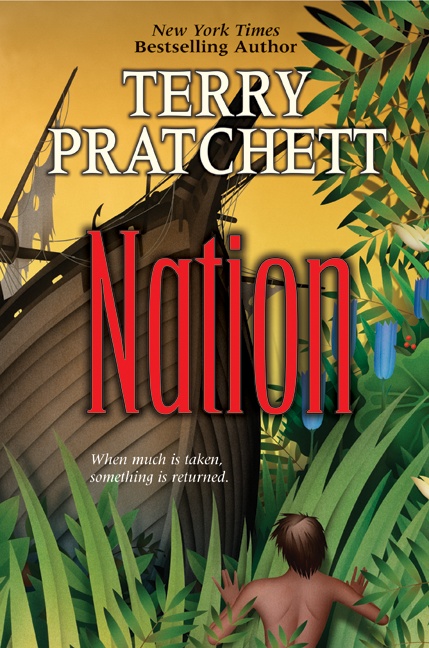
Nation - by Terry Pratchett (it's funny)


Nation is a good story. Humourous, adventurous, insightful. It brings together, in times of great human tragedy, a native islander boy on a very isolated South-Pacific-esque island in the fictional Pelagic Ocean (brilliant touch) and a woman of high British society, the nobility, the class of people that work their way into many books I read and I really enjoy them.

I picked this book up in the middle of reading Wizard and Glass, book IV of the Dark Tower series, so I was feeling epic and dark. Not really in the mood for such a light read, but I won’t hold it against Terry Pratchett. His humour is relentless, consistent and puts a smile on my face throughout the book.

Mau, the protagonist, returns to his home island after being sent out on a rite of passage, arriving just after a catastrophic tsunami washes away his entire home civilization. He is met there by a shipwrecked Lady, named Ermintrude but decides to go by Daphne instead. Very much an upgrade. Anyway, the first part revolves around the integration of two completely opposite cultures learning to survive on an island, all whilst Mau fights his own internal battle with the Grandfathers, a religion of sorts amongst the islanders, whom he blames for the deaths of everyone he has ever known and loved, and further struggling to follow the traditions that helped build his Nation and ensure their survival but denying other traditions that seem pointless now. It makes for great internal conflict, and the fact that the two parties are so poor at understanding one another, seeing eye to eye, things tend to get solved more by rationalizing than by clinging to traditions. Traditions only go so far for Daphne, who is from high British society but shipwrecked with only an islander as her companion; and Mau as well, who feels that traditions failed to protect people from the horrors of mother nature.

Pictured: Terry Pratchett's teeth, beard and novel.
Smoke signals are sent out, by means of a continuous bon fire, and people from nearby islands begin arriving. Soon enough there is a new Nation being built, led by a young man who is named Chief very unconventionally, not having gone through the official rites of the transition from boyhood to manhood usually granted to people who pass the test that Mau indeed passed.

When mutineers-cum-pirates from Daphne’s ship, the Sweet Judy, find their way to the island and threaten violence, the Nation and Mau stand strong. And it isn’t until her father, crowned as King by virtue of everyone dying to some epidemic of influenza, rescues them that we see Daphne’s struggles fitting back into British society. One Western party arrives on the island to use brute force and take it over, and claim the white girl of course, whilst the other comes to plant a British flag and claim the island as a new port, as well as to bring the girl back to high society, albeit in a more peaceful, civilized manner. Both are wrong, and both are made to see the error of their ways, yet Daphne still returns to the place where she can be of more use to the islanders, helping set up science foundations that study the secrets that the island beholds, most notably its ties to early man and the first conquests of the world.

I believe it is a clever book, set in a cleverly made up South-Pacific-like fictional place in an alternate history universe. The people develop as we’d like to see people develop, breaking senseless traditions in the name of progressing as a young nation, discovering science, history, and other cultures with the help of the dominant, ever well-funded and supplied Royal Kingdom. One of the better light reads and, as always with Pratchett, very funny in many places, even if his humour is a bit exhausting at times.